
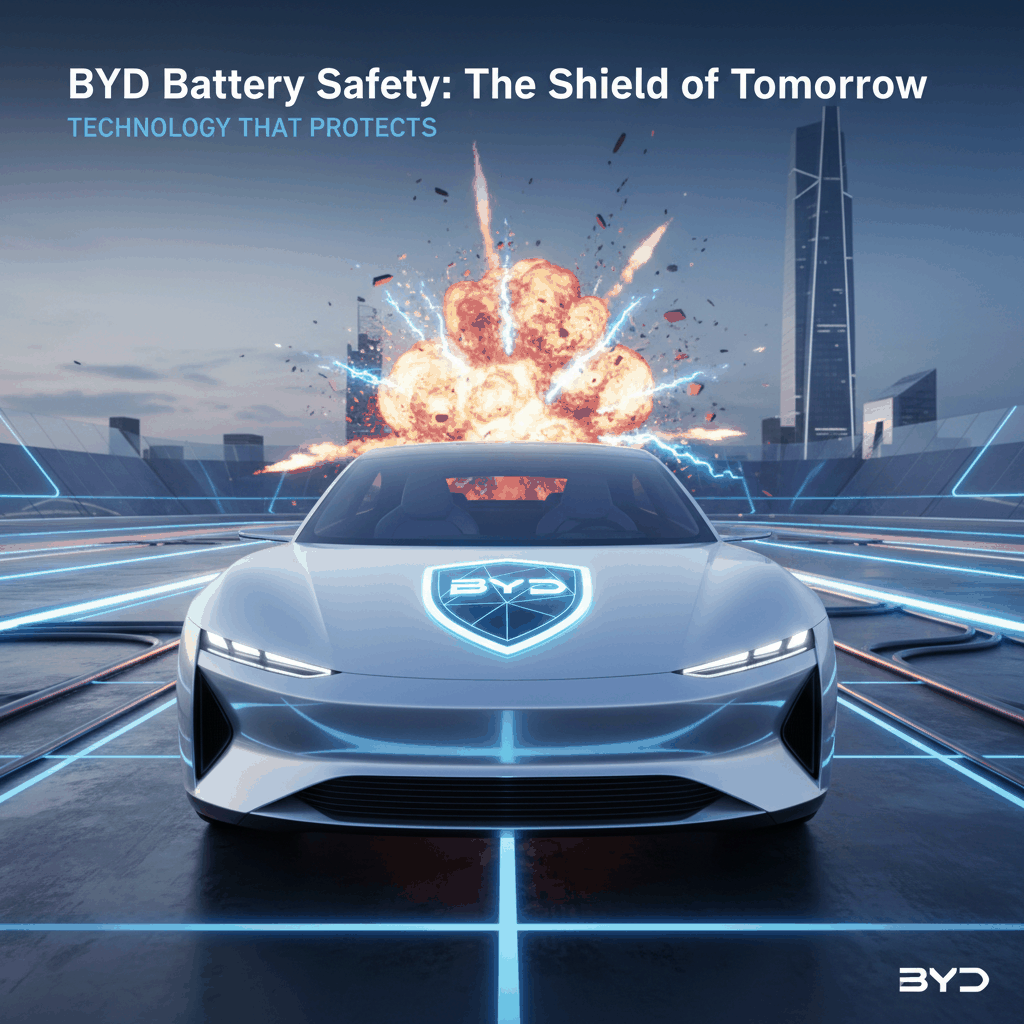
In a world where electric vehicles (EVs) are becoming increasingly common, safety remains a top concern for many potential buyers. While we often hear about crash test ratings and driver-assist features, battery safety is a fundamental aspect that can be overlooked. A recent, dramatic event has brought this topic into sharp focus, showcasing the incredible resilience of modern EV battery technology. A BYD electric vehicle reportedly withstood the blast from a nearby missile explosion during a conflict, emerging with its battery pack intact and showing no signs of fire or explosion.
This remarkable incident goes beyond standard safety tests, offering a real-world testament to the engineering and innovation behind BYD’s battery technology. It highlights not just the durability of the vehicle’s structure but the exceptional stability of its core power source. This post will explore BYD’s leadership in battery safety, detailing the technology that makes such incredible resilience possible and discussing the wider implications for the entire EV industry.
The Core of BYD’s Safety: The Blade Battery
At the heart of BYD’s reputation for safety is its groundbreaking Blade Battery. Introduced in 2020, this technology represents a significant departure from conventional lithium-ion battery designs. Instead of bundling multiple small, cylindrical cells into modules, the Blade Battery uses long, flat single cells arranged in an array. This unique structure is the key to its enhanced safety, durability, and performance.
Structural Integrity and Space Optimization
The design of the Blade Battery fundamentally changes the nature of the battery pack. Each “blade” acts as a structural beam, contributing to the overall strength of the pack. When these blades are arranged together, they create an incredibly strong, honeycomb-like aluminum structure. This innovation eliminates the need for traditional modules, which frees up over 50% more space within the battery pack compared to conventional designs.
This extra space is used to fit more active material, increasing energy density and providing a longer range. More importantly, the integrated, cell-to-pack design enhances the pack’s ability to resist impact and deformation. The Blade Battery itself becomes a stressed member of the vehicle’s chassis, contributing to the car’s overall rigidity and crash performance.
Unmatched Thermal Stability
One of the biggest concerns with EV batteries is thermal runaway—a chain reaction where a damaged cell overheats, causing adjacent cells to overheat, potentially leading to fire or explosion. BYD addressed this head-on by using Lithium Iron Phosphate (LFP) as the cathode material for its Blade Battery.
LFP chemistry is renowned for its exceptional thermal stability. It can withstand high temperatures without breaking down and releasing oxygen, which is a key contributor to thermal runaway in other lithium-ion chemistries. BYD’s Blade Battery has demonstrated this stability in some of the industry’s most demanding tests.
Pushing the Limits of Battery Safety Testing
While real-world incidents provide undeniable proof, BYD’s commitment to safety is rooted in rigorous and transparent testing that goes far beyond industry standards.
The Nail Penetration Test
The nail penetration test is considered the “Mount Everest” of battery safety tests. It simulates a severe internal short circuit by piercing the battery cell with a metal nail. Many traditional ternary lithium batteries will violently combust or explode during this test.
In public demonstrations, the BYD Blade Battery has passed this test with remarkable results. When penetrated, it emits no smoke or fire, and its surface temperature remains at a safe, low level of 30-60°C. This demonstrates its incredible resistance to thermal runaway even under the most extreme conditions of internal damage. The battery that survived a missile blast essentially passed the ultimate, unplanned penetration and impact test.
Beyond the Standard: Crushing, Heating, and Overcharging
BYD’s safety protocols include a battery of other extreme tests:
- Crushing Test: The battery pack withstands being crushed by a heavy truck without catching fire or exploding.
- Heating Test: The battery is heated in a furnace to 300°C without incident.
- Overcharging Test: The battery is overcharged by 260% without resulting in fire or explosion.
These tests prove that the Blade Battery’s safety is not a singular feature but a comprehensive characteristic built into its chemistry and structural design. This level of safety provides drivers with peace of mind, knowing their vehicle is designed to protect them even in worst-case scenarios.
What This Means for the Future of EVs
The story of a BYD vehicle surviving a blast is more than just a testament to one company’s engineering. It sets a new benchmark for what consumers should expect from electric vehicles and has broader implications for the industry.
Raising the Bar for Safety Standards
This incident challenges the entire automotive industry to prioritize battery safety with the same intensity as structural crashworthiness. As EVs become mainstream, manufacturers have a responsibility to adopt technologies that minimize the risks associated with high-voltage battery systems. BYD’s success with the LFP-based Blade Battery proves that superior safety does not have to come at the expense of performance or range.
Building Consumer Trust
For many people considering an EV, “what if” scenarios involving accidents and battery fires are a major concern. High-profile incidents, while rare, can fuel public anxiety. However, powerful real-world examples of resilience, like this one, are crucial for building trust. When consumers see an EV battery withstand an explosion, it directly counters the narrative of EV fragility and reinforces the message that these vehicles are built to be robust and safe.
The Power of Vertical Integration
BYD’s leadership in battery safety is also a result of its unique position as a company that controls its entire supply chain. From mining raw materials to designing cells, manufacturing packs, and building the final vehicle, BYD oversees every step. This vertical integration allows for unparalleled quality control and the ability to innovate rapidly, ensuring that safety is integrated into the product from the ground up, not just added as an afterthought.
Safety You Can Rely On
The dramatic survival of a BYD EV in a conflict zone is a powerful, real-world validation of the company’s long-standing commitment to safety. It showcases how the innovative design of the Blade Battery, combined with the inherent stability of LFP chemistry, creates a power source that is exceptionally resilient.
This event transforms the abstract concept of battery testing into a tangible story of protection and reliability. It demonstrates that with the right technology and engineering focus, electric vehicles can be among the safest cars on the road. For current and future EV owners, this level of safety provides not just confidence, but true peace of mind for the journey ahead.