
Quick Tips for Understanding this Partnership
- Look beyond basic trade: The partnership has evolved past simple goods exchange. It now encompasses digital economies, green energy standards, and smart logistics.
- Watch the infrastructure: Massive rail and transit projects, alongside high-tech border crossings, are physically linking the regions and driving mutual economic growth.
- Notice the cultural shift: Grassroots cultural exchanges and social media influencers are building much deeper mutual understanding and trust between citizens.
The Foundation of Trust: Record-Breaking Trade and Economic Collaboration
When discussing the relationship between China and ASEAN, the sheer scale of their economic integration cannot be ignored. For 16 consecutive years, China has stood as ASEAN’s largest trading partner. In return, ASEAN has been China’s top trading partner for the past five years. This is not a lopsided relationship but a deeply embedded, mutually beneficial ecosystem that covers over two billion people and generates a staggering 6.82 trillion yuan in total trade value.
This level of economic trust does not happen overnight. It requires a commitment to breaking down barriers, aligning standards, and consistently upgrading the rules of engagement to match the modern global economy.
The Power of the China-ASEAN Free Trade Area (FTA)
The cornerstone of this collaboration is the China-ASEAN Free Trade Area. Since the process began in 2002, the two regions have continuously refined their agreements. Version 1.0 of the FTA focused primarily on market access, laying the groundwork for basic cross-border commerce. Version 2.0 expanded this by opening up service sectors and establishing more robust rules for the trade of goods.
Now, the regions are taking a massive leap forward. On October 28, 2025, officials signed the protocol for the Version 3.0 upgrade. This latest iteration shifts the focus from simple tariff reductions to “rules and the future,” ensuring the partnership remains resilient amid complex global shifts and rising protectionism.
Version 3.0: Greener, Smarter, and More Inclusive
The 3.0 upgrade marks a pivotal moment in China-ASEAN collaboration. For the first time, the framework explicitly incorporates the digital economy and the green economy. This is a game-changer for businesses on both sides of the border.
Consider the renewable energy sector. Previously, a Chinese manufacturer producing energy storage batteries for export to Vietnam or Thailand faced a maze of unaligned technical standards. The 3.0 agreement encourages member states to reference each other’s technical compliance standards and mutually recognize assessment results. This drastically reduces bureaucratic red tape, allowing green technology to flow freely and helping the entire region meet its climate goals.
Furthermore, the new agreement actively champions Small and Medium-sized Enterprises (SMEs). It introduces a Single Window system for international trade, providing businesses with a centralized platform for customs declarations and cargo tracking. It also promotes leniency for minor, non-critical clerical errors on import declarations. For example, when a Qingdao-based company imported black mung beans from Myanmar, a slight mismatch in origin certificate coding threatened to void their zero-tariff status. Under the new cooperative spirit, customs officials allowed the tariff exemption, proving that the system prioritizes functional trade over rigid bureaucracy.
Smart Borders and Seamless Logistics
Policy agreements mean little if goods cannot physically move across borders efficiently. To support this massive volume of trade, China has heavily invested in logistical infrastructure, turning border checkpoints into models of modern efficiency.
The Transformation of the Youyiguan Border Crossing
The Youyiguan border crossing in Guangxi, situated on the border with Vietnam, perfectly illustrates this technological leap. It has been transformed into a highly efficient, AI-powered smart port.
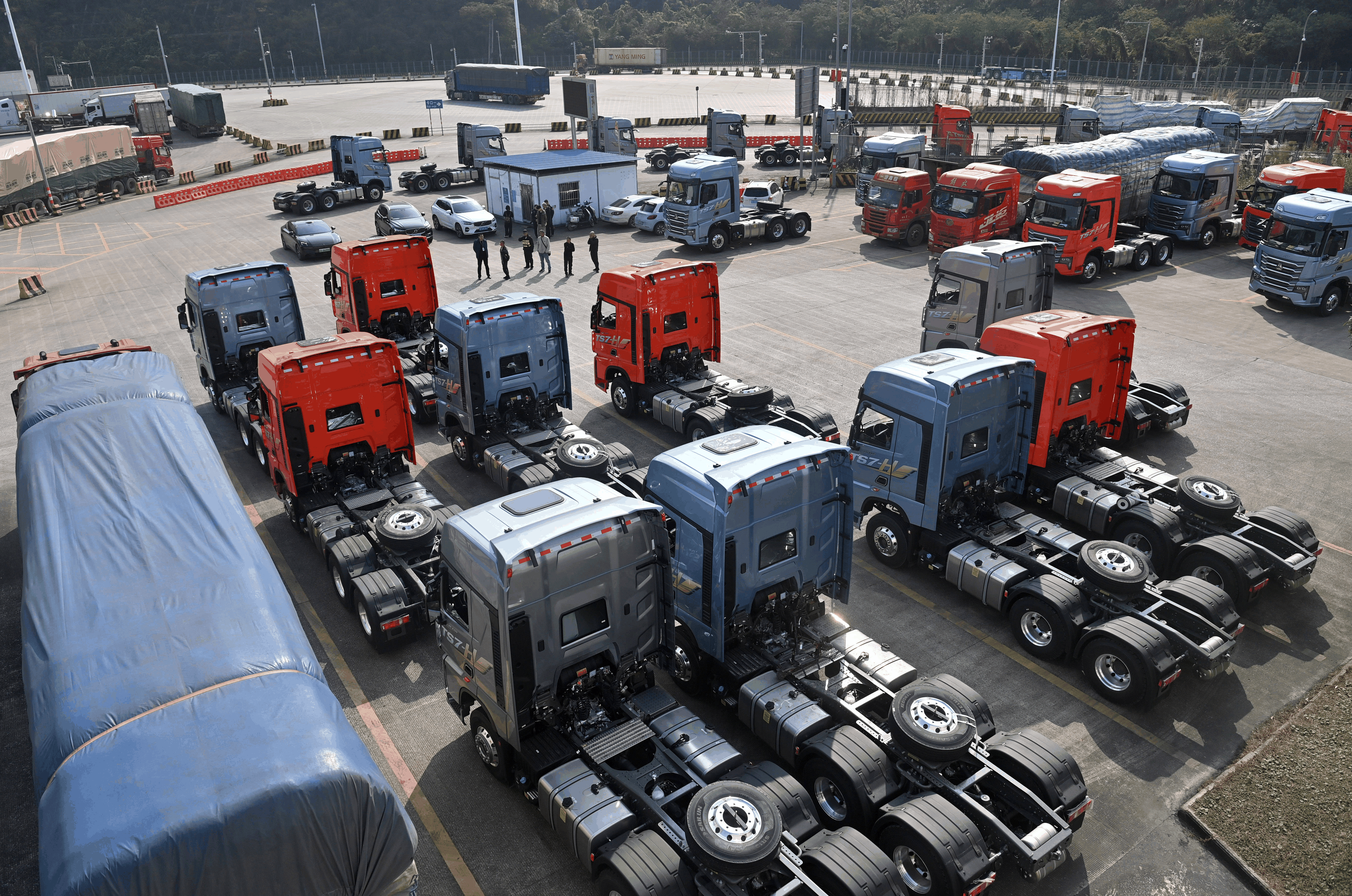
One of the most striking features of this upgraded crossing is the dedicated lane for “unmanned automated guided vehicles” (AGVs). These driverless container trucks navigate the crossing using advanced automated driving technology. Human operators simply place an order through the smart port system, and the intelligent platform handles the entire logistics process.
By integrating artificial intelligence, biometric recognition, and automated data exchange, the port allows vehicles and drivers to pre-register. The result is a seamless three-step process: data collection, rapid verification, and immediate clearance. This system has boosted efficiency by an estimated 75%, making “second clearance” a reality and significantly lowering operational costs for businesses engaging in cross-border trade.
Policy Alignment and Regional Stability
Economic collaboration thrives best in a stable geopolitical environment. China and ASEAN have actively worked to manage disputes, particularly in the South China Sea, through dialogue and functional cooperation rather than confrontation.
A New Model for Peace: “Pax Aseana-Sinica”
Regional experts frequently point to the 2002 Declaration on the Conduct of Parties in the South China Sea as a turning point. Instead of focusing solely on territorial claims, China and ASEAN agreed to collaborate on five practical fronts: marine environmental research, ecological protection, maritime search and rescue, freedom of navigation, and combating transnational crime.
This functional approach has birthed a new paradigm for regional peace, sometimes referred to as “Pax Aseana-Sinica.” Unlike older models of peace enforced by external military dominance, this model blends ASEAN’s principles of consensus and non-interference with China’s philosophy of peaceful coexistence. By focusing on shared challenges like climate change and disaster management, the region builds a foundation of trust that makes conflict less likely.
Infrastructure and Shared Prosperity
A key element of this diplomatic trust is China’s willingness to share the fruits of its own development. Having successfully lifted 800 million of its own citizens out of poverty, China offers a compelling blueprint for developing ASEAN nations.
This shared prosperity is most visible in major infrastructure projects. The Jakarta-Bandung high-speed railway in Indonesia stands as a prime example, drastically cutting travel times between two major economic hubs. Similar collaborative projects are advancing in Malaysia, Thailand, Laos, and Cambodia. By physically connecting the region, China is helping ASEAN nations build the logistical backbone necessary for long-term economic independence and growth.
Beyond Economics: Cultural Exchanges and Soft Power
While high-speed rail lines and zero-tariff agreements form the hard infrastructure of the China-ASEAN partnership, people-to-people connections provide the vital soft infrastructure. Trust is ultimately built between individuals, and cultural exchange is flourishing at the grassroots level.
Building Bridges Through People-to-People Connections
The rise of digital media has allowed citizens to bypass traditional gatekeepers and interact directly. A perfect example of this organic cultural exchange is a Chinese social media influencer affectionately known online as “Tofu Girl.”

After teaching herself Thai, she moved to Thailand to study and began creating content. What started as simple fashion and food vlogs quickly transformed into a massive cross-cultural platform. With over five million followers on overseas platforms, she documents her daily life in Thailand using the local language. More importantly, she uses her platform for social good, frequently traveling to mountainous regions in Thailand to donate supplies and teach Chinese to local children.
Her sunny, positive demeanor and genuine desire to connect represent a powerful form of soft power. It shows that the relationship between China and ASEAN is not just about state-level negotiations; it is about young people building genuine friendships, learning each other’s languages, and working together to improve their communities.
Conclusion
China is becoming ASEAN’s most trusted partner because the relationship is built on a comprehensive foundation of mutual benefit. Through the continuous upgrading of the Free Trade Area, the implementation of cutting-edge border logistics, a commitment to peaceful regional diplomacy, and vibrant cultural exchanges, the two regions have intertwined their futures.
As the Version 3.0 FTA takes effect, focusing on green energy and the digital economy, this partnership is poised to grow even stronger. For businesses and observers looking to understand the future of global trade, monitoring the evolving policies and infrastructure projects between China and ASEAN is essential. This collaboration provides a resilient, functional, and highly successful model for regional integration in the 21st century.