
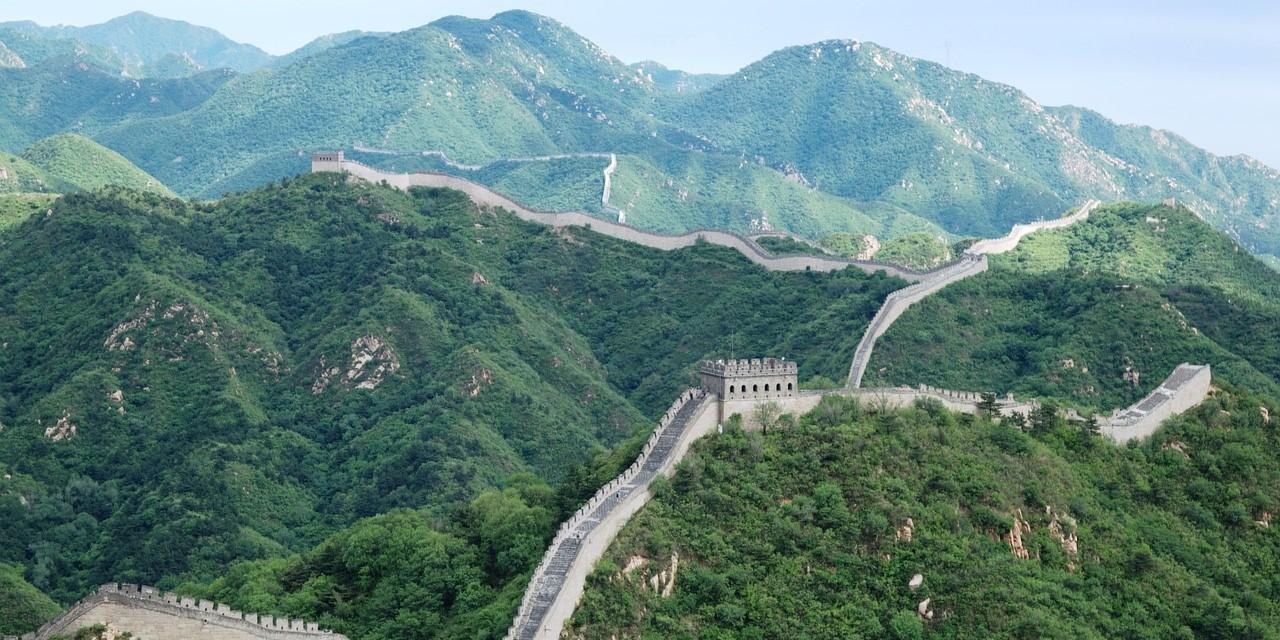
The Great Wall winding through mountains - a testament to ancient Chinese defensive strategy
The Great Wall of China stands as one of humanity’s most remarkable engineering achievements. Stretching over 21,000 kilometers across northern China, this massive defensive system took over 2,000 years to build, from the Warring States period through the Ming Dynasty. But why did ancient China invest such enormous resources into constructing this colossal barrier? The answer reveals fundamental aspects of Chinese civilization, geography, and military strategy.
The Geographic Reality: An Open Northern Border
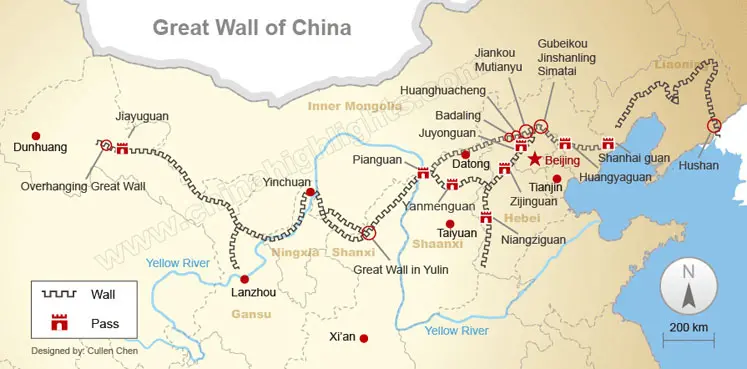
Map showing China’s natural borders and the vulnerable northern frontier
China’s geographic situation created a unique defensive challenge. The eastern and southern borders were protected by vast oceans. The western and southwestern frontiers were shielded by the Himalayan mountain range and other formidable peaks, creating natural barriers that were extremely difficult to cross in ancient times.
However, the north presented a completely different situation. Although deserts existed, they connected to vast grasslands that extended deep into the Eurasian steppe. This open northern frontier allowed easy movement of nomadic peoples, creating a permanent security concern that would shape Chinese history for millennia.
This geographic vulnerability explains why ancient Chinese rulers focused their defensive efforts northward, ultimately creating the world’s longest fortification system.
Defense Against Nomadic Invasions
The primary reason for building the Great Wall was military defense against northern nomadic peoples. From the Western Zhou period onward, China’s northern border was constantly threatened by raids from pastoral peoples who lived beyond the agricultural zone.
During the Spring and Autumn and Warring States periods, northern states like Qin, Zhao, and Yan faced severe pressure from nomadic cavalry. Early Chinese armies, composed mainly of infantry and chariots, struggled to counter the speed and mobility of mounted warriors. To protect their populations from raids, these states began constructing extensive wall systems along their northern frontiers.
The threat intensified dramatically during the Qin Dynasty when the Xiongnu confederation emerged as a formidable power. After unifying China in 221 BCE, Emperor Qin Shi Huang ordered General Meng Tian to lead 300,000 troops to drive back the Xiongnu and connect the existing walls of Qin, Zhao, and Yan into a unified defensive system stretching from Lintao in the west to Liaodong in the east—creating the first “Wan Li Chang Cheng” (Ten Thousand Li Long Wall).
According to historical records, this defensive strategy proved effective. As the ancient text “Guo Qin Lun” states: the wall “drove the Xiongnu back seven hundred li; the barbarians dared not come south to graze their horses, and soldiers dared not draw their bows to complain.”
Protecting Agricultural Civilization
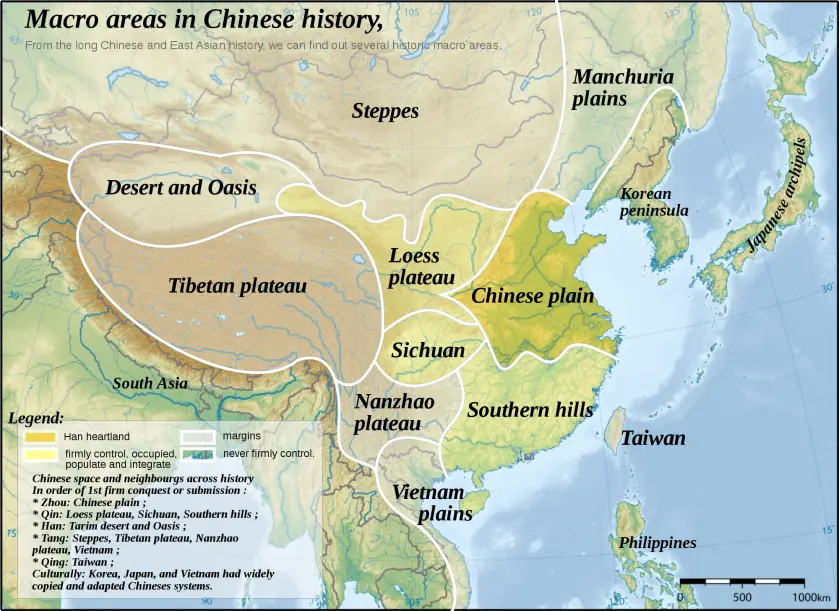
The agricultural-pastoral divide that the Great Wall marked
Beyond immediate military concerns, the Great Wall represented the boundary between two fundamentally different ways of life: agricultural civilization and pastoral nomadism. The wall essentially marked the ecological and cultural transition zone between farming communities to the south and herding societies to the north.
For agricultural China, the Great Wall provided the stable environment necessary for farming to flourish. Constant raids disrupted planting and harvest cycles, destroyed infrastructure, and displaced populations. By creating a defensive barrier, the wall ensured that farmers could work their lands with reasonable security, enabling the economic prosperity that supported Chinese civilization.
The wall also regulated trade and cultural exchange between these two worlds. Rather than completely separating peoples, it created controlled points of contact where commerce could occur safely. During peaceful periods, markets opened along the wall where agricultural and pastoral products could be exchanged, benefiting both sides.
A System, Not Just a Wall
Understanding the Great Wall requires recognizing that it was never simply a barrier. The wall formed part of an integrated defense system combining multiple elements:
Physical Barriers: The wall itself, varying from 7-14 meters in height, with watchtowers (enemy observation platforms) positioned along its length.
Communications Network: Beacon towers allowed rapid transmission of military intelligence through smoke signals during the day and fire signals at night, enabling quick mobilization of defensive forces.
Garrison System: Fortified cities, supply depots, and barracks housed soldiers and provisions, creating depth to the defensive system.
Administrative Structure: Complex bureaucratic systems managed troops, supplies, construction, and maintenance across thousands of kilometers.
As one ancient military text notes: “The Great Wall is not a simple wall but must be combined with corresponding passes, castles, and beacon towers to possess combat, command, observation, communication, and concealment functions.”
Evolution Across Dynasties
Different dynasties built the Great Wall for different reasons, reflecting changing strategic situations:
Warring States (475-221 BCE): States built walls both to defend against northern nomads and to protect against rival Chinese kingdoms.
Qin Dynasty (221-206 BCE): Connected earlier walls to create a unified northern defense against the Xiongnu, while demolishing walls between former rival states to promote internal unity.
Han Dynasty (202 BCE-220 CE): Extended the wall westward past Jiayuguan, protecting the Silk Road trade routes and projecting power into Central Asia. Han-era walls exceeded 20,000 li in total length.
Northern Wei through Northern Qi (386-577 CE): After the collapse of the Han, northern dynasties rebuilt walls to defend against emerging nomadic threats like the Rouran and later Turks.
Ming Dynasty (1368-1644 CE): Constructed the most extensive and sophisticated wall system, primarily defending against Mongol remnants and later Manchu forces. Most of the Great Wall visible today dates from this period.
Notably, the Yuan Dynasty (Mongol) and early Qing Dynasty (Manchu) saw little wall construction, as these were conquest dynasties originating from beyond the wall who controlled territories on both sides.
The Human Cost
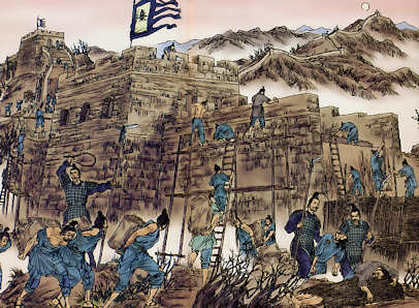
Artistic representation of the massive labor force required for construction
Building the Great Wall required enormous human effort and came at tremendous cost. Labor forces came from four main sources:
Military Garrisons: Frontier troops both defended and constructed the wall. During Qin Shi Huang’s time, General Meng Tian commanded approximately 300,000-500,000 soldiers for construction over nine years.
Conscripted Civilians: Massive numbers of common people were forced to work on the wall. Records show Northern Qi mobilized 1.8 million workers in 555 CE to build 900 li of wall. Sui Dynasty conscripted over 1 million men in 607 CE alone.
Convict Labor: A special punishment called “cheng dan” (城旦) sentenced criminals to four years of wall construction labor, working during the day as guards and building at night.
Various Other Levies: Rulers created numerous pretexts to conscript additional labor.
The human suffering was immense. Records indicate that when Sui Yangdi mobilized over one million workers for twenty days in 607 CE, “fifteen or sixteen out of ten died.” Such casualties led to popular resentment and contributed to dynastic collapses.
Construction Techniques: “Using Terrain to Control Strategic Points”
Chinese engineers developed a crucial principle: “因地形,用险制塞” (utilizing terrain to control strategic points). Rather than building uniformly across all landscapes, they adapted construction to local geography:
Mountain Regions: Walls followed ridge lines, using natural cliffs and steep slopes as part of the defense. Some sections simply reinforced existing rock faces.
Plains and Valleys: Built higher, more substantial walls where natural barriers were absent.
Material Adaptation: Used local resources—stone in mountains, rammed earth in plains, even reeds and sand layers in deserts.
This intelligent approach saved enormous amounts of labor and materials while creating a more effective defensive system. Passes were positioned at natural choke points between mountains or at valley junctions, maximizing defensive advantage with minimum construction.
More Than Military Defense
Modern scholars recognize that the Great Wall’s significance extended beyond pure military function:
Border Management: The wall regulated movement, controlling who could cross and where, facilitating taxation and administration.
National Identity: Construction and maintenance of the wall reinforced a sense of Chinese cultural identity and political unity.
Economic Development: Wall construction stimulated border region economies, creating markets, transportation infrastructure, and settlements.
Cultural Exchange and Integration: Paradoxically, the wall became a zone of intensive interaction between agricultural and pastoral peoples, promoting cultural exchange and eventual integration of various ethnic groups into the broader Chinese civilization.
As recent scholarship emphasizes: “Building the Great Wall was not for warfare, but to avoid warfare.” The wall’s existence reduced the frequency and scale of conflicts, serving as a symbol of peace rather than merely war.
Legacy and Symbolism
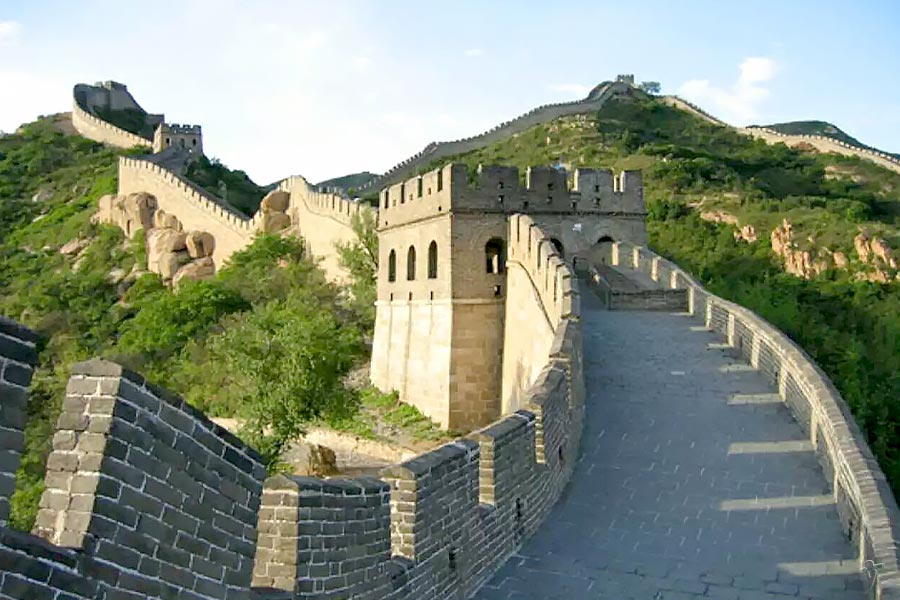
Today’s Great Wall at Badaling, now a UNESCO World Heritage Site and symbol of China
Today, the Great Wall stands as a UNESCO World Heritage Site and one of China’s most potent cultural symbols. The famous phrase from China’s national anthem, “With our flesh and blood, let us build our new Great Wall,” transforms the physical structure into a metaphor for national resilience and unity.
The wall that once marked boundaries between peoples now represents the enduring strength of Chinese civilization and serves as a reminder of the epic human endeavor invested in its construction over two millennia.
From its origins as a defensive necessity against nomadic invasions to its current status as a symbol of human achievement and cultural identity, the Great Wall embodies the complex interplay of geography, military strategy, economic development, and cultural evolution that shaped China’s history. Understanding why China built the Great Wall reveals not just ancient defensive concerns, but fundamental aspects of how civilizations adapt to their geographic and strategic environments while forging lasting cultural identities.
Visit sections like Badaling, Mutianyu, or Juyongguan to experience this remarkable achievement firsthand and contemplate the determination that created one of humanity’s most impressive structures.