
Key Points
- China has developed a highly specialized police dog (K9) system that combines centralized training, domestic breeding, and modern technology.
- The Kunming dog, a breed developed in Yunnan province, plays a key role alongside imported breeds such as German Shepherds and Belgian Malinois.
- Unlike decentralized models used in some countries, China’s K9 training is overseen by the Ministry of Public Security with uniform national standards.
- Chinese police dogs are deployed prominently in public security operations, including transportation hubs and major public events.
- Long-term, one-to-one partnerships between handlers and dogs are emphasized to maximize operational effectiveness.
From Soviet Roots to a Distinctly Chinese K9 System
China’s police dog program has undergone rapid evolution, developing into a highly specialized K9 corps with training methods and operational roles that differ notably from many international counterparts. From its early foundations in the 1950s to its current advanced stage, the program reflects a unique blend of global practices and local innovation in law enforcement.
The use of police dogs in China began in the early years of the People’s Republic, with technical assistance from the Soviet Union. Over time, however, the system moved away from direct imitation and began charting its own course. Today, China operates a nationwide network of breeding and training centers that support a wide range of public security tasks.
The Kunming Dog and China’s Breeding Strategy
One of the most distinctive outcomes of China’s independent development is the Kunming dog. Developed in Yunnan province, this wolfdog hybrid stands as a domestically bred success story. Valued for its endurance, intelligence, and strong adaptability—particularly in high-altitude environments—the Kunming dog has become a key working breed within China’s K9 units.
These dogs serve alongside imported breeds such as German Shepherds and Belgian Malinois. Together, they form a diversified canine force capable of meeting China’s varied geographic and operational demands.
Centralized Training and Uniform Standards
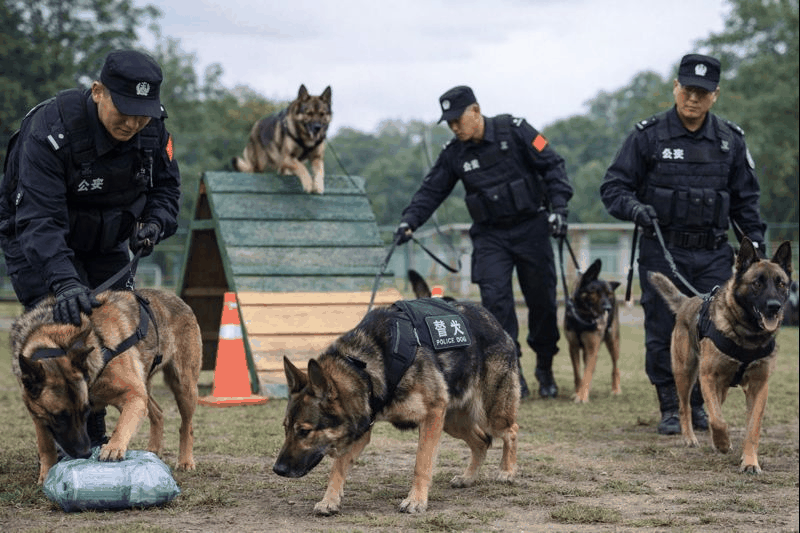
A defining feature of China’s police dog program is its highly standardized and centralized training system. Unlike in some Western countries, where K9 training may be handled by local or regional departments, China’s Ministry of Public Security oversees a unified national curriculum.
This centralized approach ensures that K9 units across the country meet consistent performance standards, regardless of location. Training is intensive and demanding, emphasizing absolute discipline and precision. Police dogs are prepared for a wide range of missions, including narcotics detection, explosive ordnance disposal, suspect tracking, and crowd control.
A Visible Role in Public Security
While police dogs worldwide share similar core responsibilities, their deployment in China shows notable differences. Chinese K9 units are frequently involved in highly visible public security operations, such as patrolling major transportation hubs and securing large-scale public events.
This proactive and visible presence serves both as a deterrent and as a symbol of public safety. In contrast, K9 units in some other countries are more commonly deployed reactively, responding to specific incidents rather than maintaining a constant public-facing role.
Lifelong Partnerships Between Dogs and Handlers
Another key aspect of China’s K9 system is the emphasis on the bond between handler and dog. This relationship is often framed as a lifelong partnership. In many cases, handlers are assigned to work exclusively with a single dog throughout its service life.
Such long-term pairing fosters a deep level of mutual trust and understanding, significantly enhancing effectiveness during real-world operations. The result is a working relationship built on familiarity, precision, and shared experience.
Integrating Technology with Traditional K9 Skills
As the program continues to advance, China is increasingly integrating modern technology into traditional K9 operations. Advanced equipment and data-driven analysis are being introduced to improve efficiency and effectiveness in complex security environments.
By combining rigorous training systems, domestically developed breeds, and technological innovation, China has cultivated a police dog force that plays a critical role in domestic security. At the same time, it offers a compelling case study in specialized K9 development on the global stage.