
Quick Facts: China’s Moon Landing Roadmap
Mission Timeline:
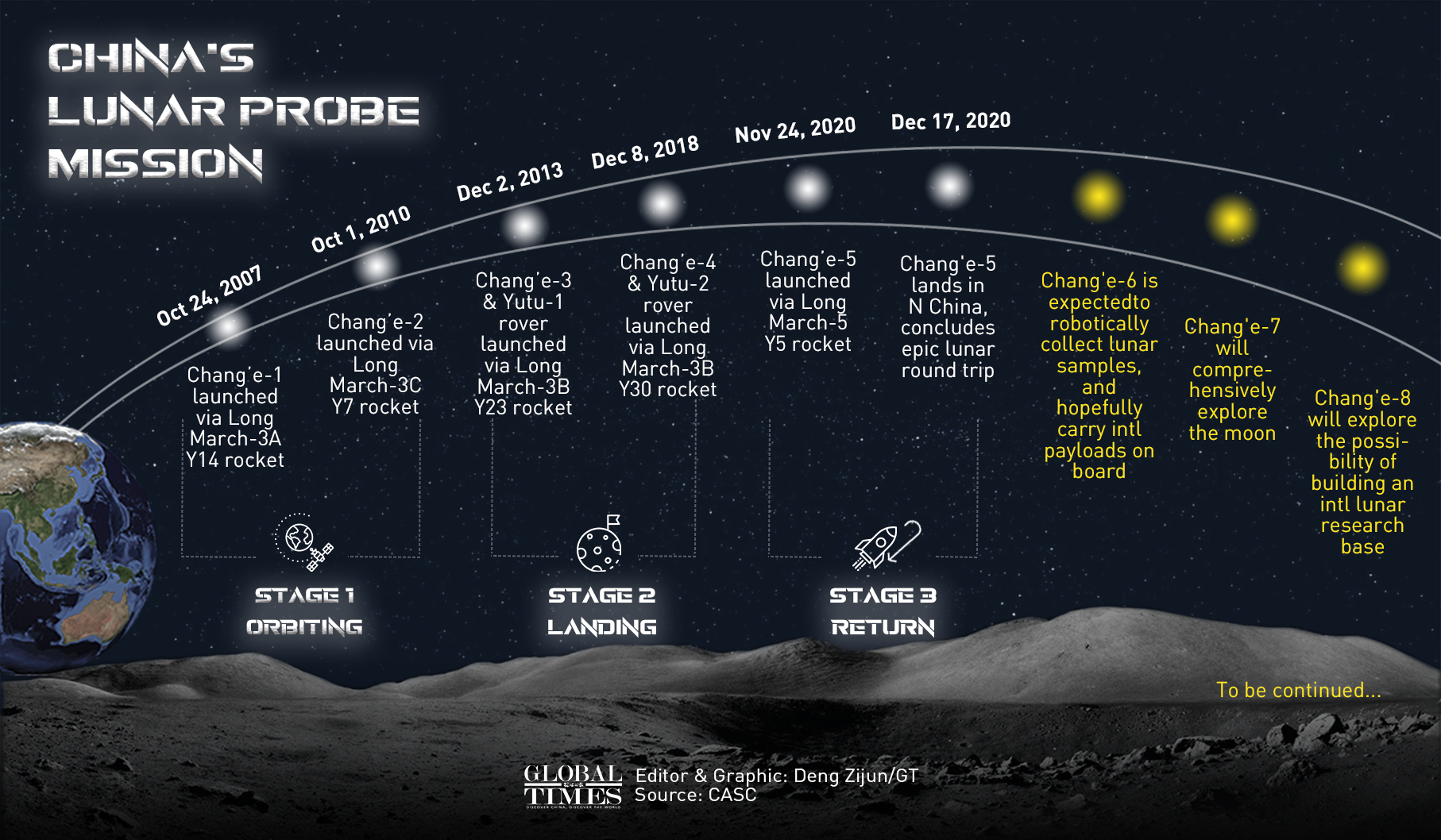
- 2007: Chang’e-1 orbited the moon
- 2013: Chang’e-3 landed with rover
- 2019: Chang’e-4 - world’s first lunar far side landing
- 2020: Chang’e-5 returned 1,731g samples
- 2024: Chang’e-6 returned 1,935g from far side (world first)
- 2026: Chang’e-7 launches (south pole exploration)
- 2028: Chang’e-8 launches (resource testing)
- 2030: First Chinese astronauts land on Moon
Crewed Mission:
- New rocket: Long March 10 (89m tall, 2,200+ tons)
- Spacecraft: Mengzhou (3 astronauts)
- Lander: Langyue (2 astronauts land, 1 stays in orbit)
- Surface time: 3+ days
- Spacesuit: Wangyu
- Rover: Tansuo
International Lunar Research Station:
- 2035: Basic version complete
- 17 countries/50+ institutions participating
- Long-term goal: permanent lunar base
From robotic missions to crewed landing - China’s systematic lunar roadmap
China’s journey to the Moon follows a methodical “three-step” strategy: unmanned exploration (complete), crewed landing (in progress), and long-term habitation (planning). This isn’t a race—it’s a carefully planned buildup of capabilities over decades.
The Strategy: “Explore, Land, Inhabit”
China’s lunar program divides into three major phases:
Phase 1: Unmanned Exploration (2004-2024) - Complete ✓
Phase 2: Crewed Landing (2023-2030) - In Progress
Phase 3: Permanent Station (2030-2040+) - Planning
The first phase itself followed three steps: orbit, land, and return samples. Each mission built on the previous one’s achievements.
Phase 1: Proving Ground (2004-2024)
Twenty years of Chang’e missions building capabilities
Step 1: Orbiting
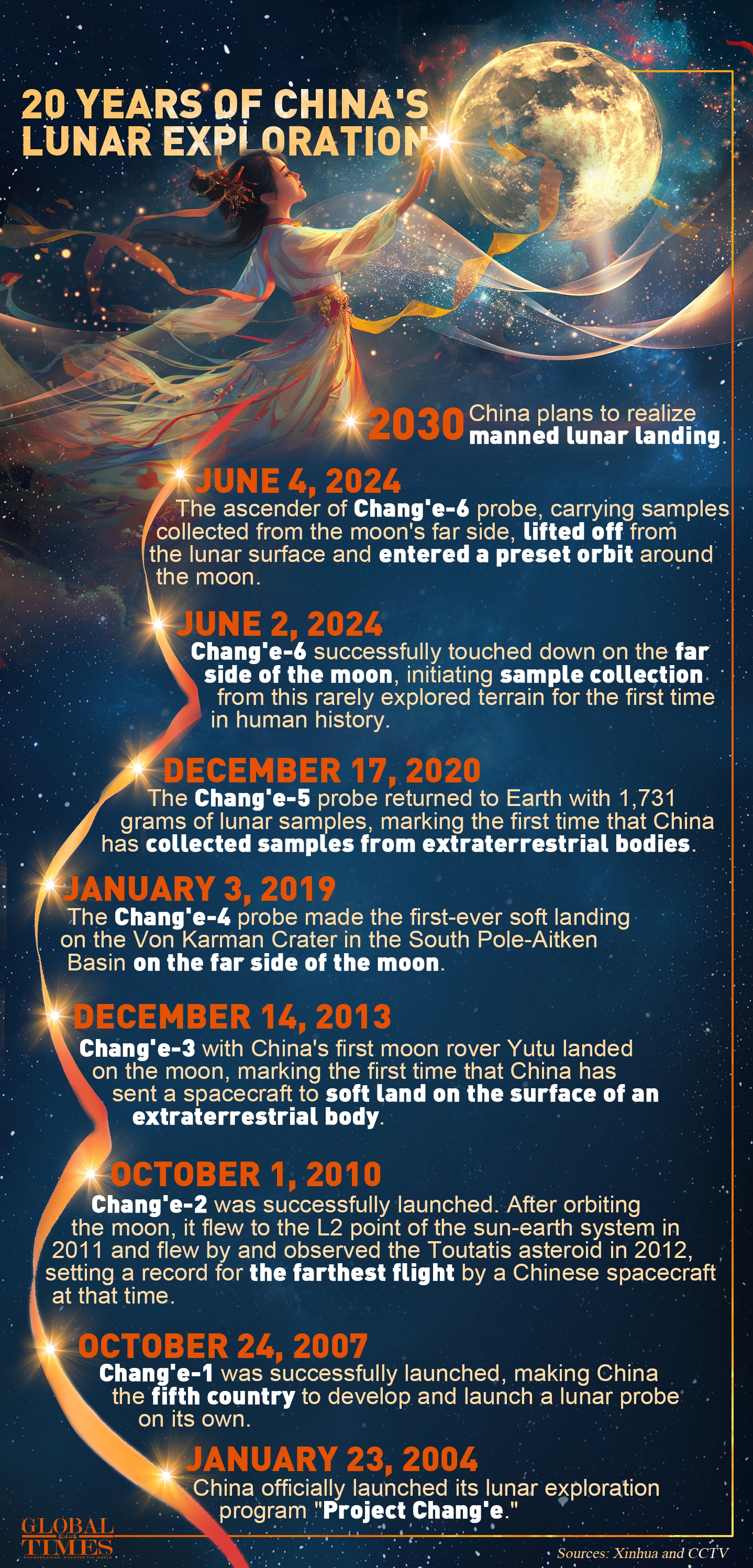
In 2004, China officially launched the Chang’e program with a budget of 1.4 billion RMB. Chang’e-1 (2007) made China the fifth country to orbit the Moon, operating for 494 days and mapping the entire lunar surface.
Step 2: Landing
Chang’e-3 (2013) achieved China’s first soft landing, deploying the Yutu rover which set records for lunar surface operation time.
The game-changer came with Chang’e-4 (2019)—humanity’s first landing on the lunar far side. This required deploying a relay satellite to enable communications, demonstrating sophisticated mission planning.
Step 3: Returning Samples
Chang’e-5 (2020) brought back 1,731 grams of lunar samples—the first new samples in 44 years.
Chang’e-6 (2024) topped this by returning 1,935 grams from the far side, a feat no other nation has accomplished. Chinese scientists discovered a new lunar mineral called “Changesite” and revealed the South Pole-Aitken Basin formed 4.25 billion years ago.
Scientific Output: Over 1,900 papers published from China’s lunar data, demonstrating serious research intent beyond flag-planting.
Phase 2: Getting Astronauts There (2023-2030)
In May 2023, China officially announced the crewed lunar mission was fully underway, targeting a landing before 2030.
The Mission Plan
Two launches send up separate components:
-
Langyue lander launches first, waits in lunar orbit
-
Mengzhou spacecraft launches with 3 astronauts
-
They dock in orbit; 2 astronauts transfer to lander
-
Lander descends; astronauts explore for 3+ days
-
Ascent module returns to orbit, docks with Mengzhou
-
Astronauts return to spacecraft, fly home
One astronaut remains in orbit the entire time, operating the Mengzhou while two colleagues explore below.
The Hardware
Long March 10 Rocket: At 89 meters tall with 2,200+ tons launch weight, it’s more than double the size of China’s current largest rocket (Long March 5). New facilities are being built at Wenchang Spaceport to accommodate it.
Mengzhou Spacecraft: Announced in February 2024, this next-generation craft will carry three astronauts to lunar orbit and back—like Apollo’s Command Module but modern.
Langyue Lander: Takes two astronauts to the surface and back to orbit. Think of it as China’s version of Apollo’s Lunar Module.
Wangyu Spacesuit: Announced February 2025, this new suit enables extended lunar surface work.
Tansuo Rover: A pressurized vehicle letting astronauts travel across the surface, expanding their exploration range.
Current Status (October 2025): All major prototypes completed. Ground systems, tracking stations, and training programs are accelerating.
Astronaut Training
In August 2024, China’s fourth batch of reserve astronauts joined training. Their curriculum includes everything from spacecraft operation to lunar rover driving, from celestial navigation to geological surveys, from weightlessness in space to load-bearing walking in lunar gravity.
Only astronauts with previous spaceflight experience will be selected for lunar missions—this is a requirement, not a hope.
Where They’ll Land
After evaluating 30 candidate sites across low, mid-high latitudes and polar regions, three locations stand out: Bode Rille, Mount Marilyn, and Mount Isam—all at lower latitudes offering good lighting, safe terrain, and scientific value.
Phase 3: Building the Foundation (2026-2028)
Before astronauts arrive, two robotic missions will prepare the way.
Chang’e-7 (2026)
This mission will survey the lunar south pole’s environment and resources with 18 scientific instruments. It’s scouting for the International Lunar Research Station, identifying water ice deposits, safe landing zones, and valuable resources.
Chang’e-8 (2028)
Chang’e-8 tests the technologies needed for long-term presence:
- Using lunar soil to make construction materials
- Growing plants in lunar conditions
- Wireless communication networks
- Energy generation and storage
- Long-term autonomous operation
Scientists are literally figuring out whether vegetables can grow on the Moon.
Phase 4: International Lunar Research Station (2035+)
The Vision
This isn’t just a Chinese base—it’s a collaborative facility involving 17 countries and over 50 research institutions. The station will be built in stages:
2035: Basic Version
- Centered on lunar south pole
- 100km operational range
- Earth-Moon communication network
- Integrated support for robotic and crewed missions
- Basic resource utilization
2040: Complete Version
- Expanded facilities and capabilities
- Advanced scientific experiments
- Multiple modules and habitats
- Regular international crew rotations
Beyond 2040: Application Version
- Industrial-scale resource use
- Permanent human presence
- Gateway for deeper space exploration
- Multi-functional lunar economy
Three Scientific Goals
Chinese scientists describe the station’s purpose as “measure the Moon, survey the sky, observe Earth”:
- Measure the Moon: Lunar geology, resources, evolution
- Survey the Sky: Astronomy from a stable, airless platform
- Observe Earth: Macroscopic Earth monitoring from 384,400km away
Why the South Pole?
The lunar south pole offers unique advantages:
- Permanently shadowed craters potentially containing water ice
- “Peaks of eternal light” offering near-continuous solar power
- Ancient geology revealing early solar system history
- Moderate temperature variations compared to equatorial regions
Why This Matters
National Achievement
Like the Apollo program for America, lunar landing inspires national pride and demonstrates capabilities. As Chinese officials note, space achievement reflects comprehensive national strength and can unite people around common goals.
Technology Spillover
Developing lunar technology drives innovation in:
- Advanced materials
- Life support systems
- Autonomous robotics
- Energy storage
- Communication networks
- Resource extraction
These technologies have Earth applications in medicine, manufacturing, communications, and environmental management.
International Cooperation Unlike the Cold War space race, China’s lunar program explicitly welcomes international partners. The 17-nation coalition shows space exploration can be collaborative rather than competitive.
Future Preparation The Moon is humanity’s stepping stone to Mars and beyond. Technologies tested on the Moon—living off-world, using local resources, operating far from Earth—are necessary before attempting more distant destinations.
Challenges Ahead
Technical: Radiation protection, life support reliability, lunar dust management, extreme temperatures (-173°C to +127°C)
Infrastructure: New launch facilities, enhanced tracking stations, astronaut training complexes, recovery systems
Schedule: Meeting 2030 while ensuring safety requires careful balance
Sustainability: Building systems that last decades, not just complete missions
The Big Picture
China’s lunar program demonstrates methodical long-term planning:
-
Learn to orbit (Chang’e-1, 2)
-
Learn to land (Chang’e-3, 4)
-
Learn to return (Chang’e-5, 6)
-
Send humans (2030)
-
Stay permanently (2035+)
Each step proves technologies needed for the next. By 2024, China has progressed from “following” other space nations to “running alongside” to partially “leading” in areas like far-side exploration.
The 2030 crewed landing is ambitious but achievable given the systematic preparation. The real vision extends beyond 2030 to a permanent, international lunar presence that serves as humanity’s first off-world settlement.
Conclusion
China isn’t rushing to the Moon—it’s building a highway there. From 2004’s program launch through successful robotic missions to the planned 2030 crewed landing and 2035 research station, every step serves the larger goal of sustainable lunar presence.
This methodical approach trades speed for reliability, spectacular headlines for steady progress, and national exclusivity for international partnership. The result is a lunar program designed not for a few brief visits but for permanent human expansion into space.
As the 2030 deadline approaches, hardware development accelerates, astronauts train, and international partners join. The Moon isn’t just a destination—it’s humanity’s first stepping stone to becoming a multi-planetary species, and China is ensuring that step is built to last.
For updates on China’s lunar program, visit the China National Space Administration (CNSA) at cnsa.gov.cn