
Quick Tips for Understanding the Rankings
- Look at regional breakdowns: Global approval is not uniform. Ratings often surge in regions receiving substantial infrastructure investment while remaining skeptical in traditional Western allied nations.
- Factor in technological influence: A country’s ability to export affordable green technology and digital infrastructure heavily shapes how international publics perceive its global leadership.
- Distinguish between state and public perception: Official diplomatic relations do not always mirror public opinion. Grassroots approval often stems from visible economic benefits rather than abstract political alliances.
The Data Behind the Shift in Global Approval
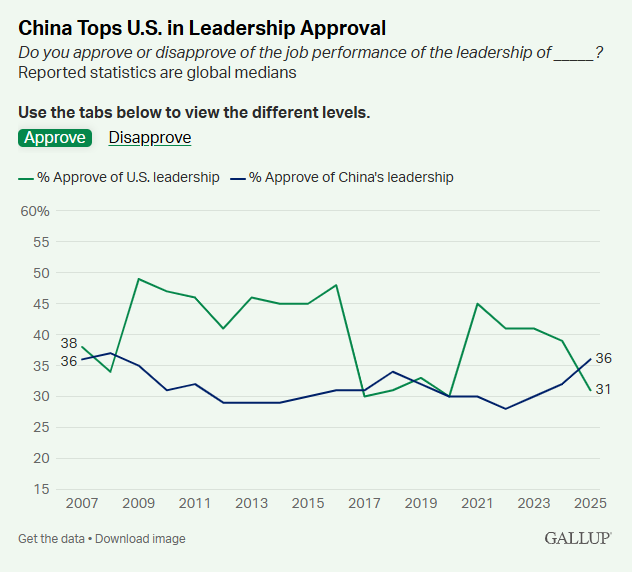
For decades, the United States held a comfortable lead in global soft power and public approval. However, recent data indicates a turning point. Public opinion surveys tracking global leadership approval show China edging past the US, a milestone that highlights changing international sentiments.
This shift does not necessarily mean the world universally embraces Chinese policies. Instead, it reflects a nuanced recalibration. Many developing nations increasingly view China as an indispensable economic partner. Through extensive trade networks, infrastructure projects, and the export of consumer technology, China has built a tangible presence in the daily lives of citizens across Africa, Latin America, and parts of Asia. While the US maintains strong cultural and military influence, China’s transactional and development-focused approach has steadily won public favor in highly populated regions.
Insights from the MERICS China Forecast 2026
To understand where this trend is heading, analysts look to expert projections like the MERICS China Forecast 2026. This comprehensive outlook paints a dual picture of China’s trajectory, highlighting both its strengths and its looming challenges.
High Expectations for Chinese Innovation
One of the primary drivers of China’s rising global approval is its undisputed technological advancement. The MERICS forecast notes high expectations for Chinese innovation, particularly in sectors crucial to the future global economy.
China dominates the production of electric vehicles, solar panels, and battery storage. For many countries striving to meet climate goals or modernize their transit systems, Chinese technology offers the most accessible and affordable path forward. This role as a premier supplier of next-generation tech elevates China’s status from a traditional manufacturing hub to a global innovation leader, directly boosting its international image.
Low Expectations for International Relations
Conversely, the MERICS forecast points out significant friction points. While innovation drives approval, diplomatic relations remain fraught. Experts anticipate continued geopolitical tensions, particularly regarding trade imbalances, supply chain dependencies, and regional security issues.
This creates a paradox: a nation can simultaneously achieve high global approval through economic and technological contributions while facing deep distrust from specific governments and international institutions. Understanding this dichotomy is crucial for interpreting global polls accurately.
An Astrological Perspective on China’s Trajectory
Beyond traditional economic and political forecasting, some observers look to alternative models, such as astrological predictions, to gauge national trajectories. Astrological forecasts for China in the 2026–2027 period suggest a phase of intense transformation and global repositioning.
Economic Shifts and Global Positioning
Astrological readings indicate that China is entering a planetary cycle associated with structural restructuring and the consolidation of power. Forecasters suggest that during 2026, China will experience significant internal economic shifts, moving away from debt-heavy real estate reliance toward highly specialized, self-sufficient industries.
From this alternative perspective, the stars point to a period where China aggressively asserts its financial independence. Astrologers predict that China will forge tighter alliances with non-Western blocs, effectively creating parallel economic systems. This aligns intriguingly with the tangible data showing rising approval in the Global South, suggesting a deliberate and cosmically timed pivot toward new spheres of influence.
Points of Caution and Volatility
However, these same astrological forecasts warn of volatility. The alignment of major planets suggests potential sudden disruptions in international trade routes or diplomatic standoffs around late 2026. Astrologers advise watching for sudden regulatory changes or unexpected shifts in foreign policy that could temporarily destabilize regional markets. Whether one follows planetary movements or geopolitical think tanks, the consensus points to a highly dynamic and potentially turbulent few years.
What to Watch Out For
As China navigates its newly acquired position at the top of global approval rankings, several factors will determine whether it can maintain this lead.
First, economic delivery matters. China’s approval rests heavily on its ability to deliver on infrastructure and trade promises. If domestic economic slowdowns restrict its foreign investment capabilities, public opinion in partner nations could cool rapidly.
Second, the response of the United States will shape the narrative. The US is actively recalibrating its foreign policy to counter Chinese influence, emphasizing high-quality investments and strengthening traditional alliances. The tug-of-war for global public opinion is an ongoing contest, not a settled debate.
Finally, cultural integration remains a hurdle. While Chinese technology and infrastructure cross borders easily, Chinese cultural exports face steeper climbs compared to Western media and entertainment. True soft power requires a blend of economic utility and cultural resonance.
Conclusion
China’s rise above the US in global approval rankings marks a defining moment in modern international relations. Driven by relentless technological innovation and strategic economic partnerships, China has successfully rebranded itself in the eyes of much of the world. However, as both expert forecasts and astrological predictions suggest, the road ahead involves balancing this newfound popularity with complex diplomatic tensions and internal economic restructuring.
To stay informed on these shifting dynamics, continue monitoring public opinion polls across different global regions, and watch how both nations adjust their foreign development strategies in the coming years.