
Key Points
- Economic Scale: China’s GDP is significantly larger than India’s—roughly five to six times the size—positioning it as the world’s second-largest economy compared to India’s fifth.
- Population Trends: India has surpassed China to become the world’s most populous nation. While China’s population is shrinking and aging, India’s is growing and youthful.
- Workforce Dynamics: China faces a labor shortage due to an aging society, forcing a shift toward high-tech manufacturing. India benefits from a “demographic dividend” with a massive, young workforce ready to enter the market.
- Urbanization: China is highly urbanized (over 65%), facilitating industrial clusters. India remains largely rural (around 35-36% urban), which presents infrastructure challenges but also massive potential for future urban growth.
- Growth Trajectory: India is currently experiencing faster GDP growth rates than China, as China’s economy matures and stabilizes.
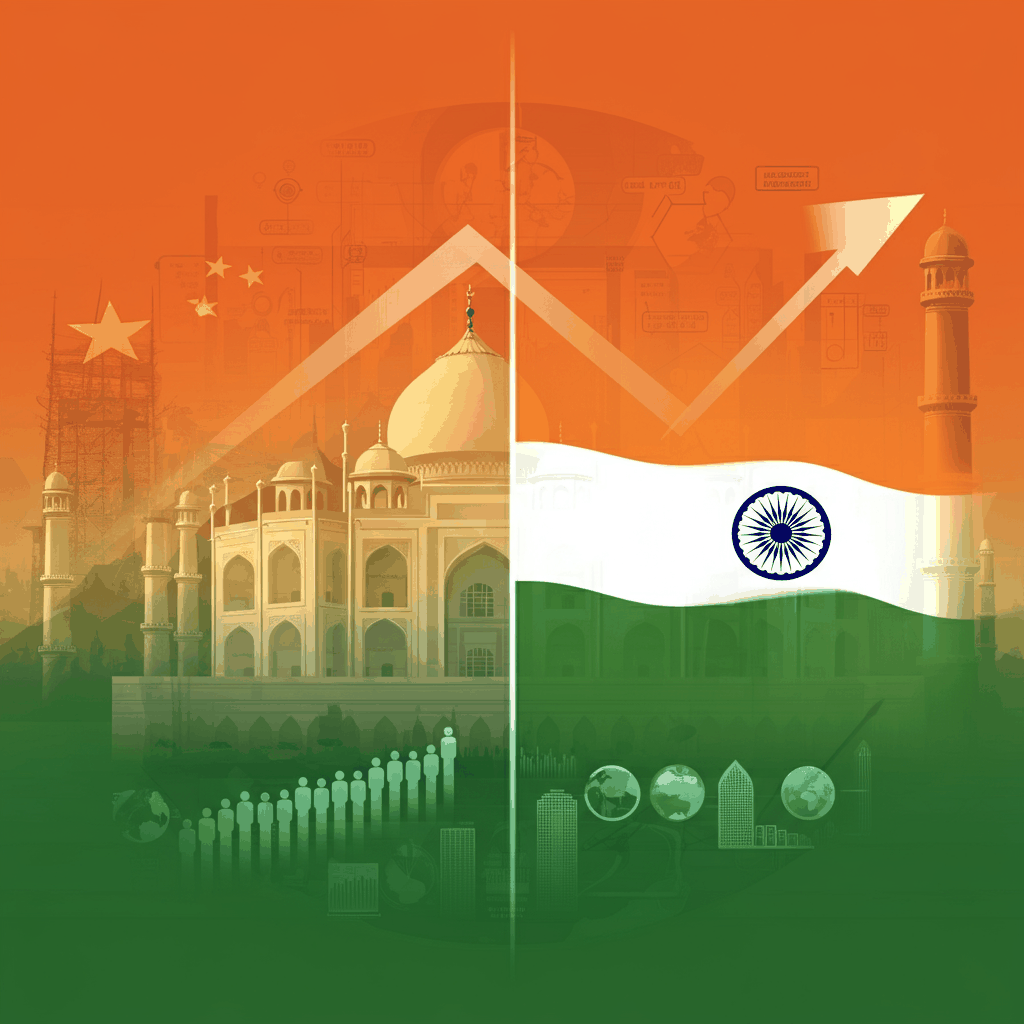
For decades, economists and geopolitical observers have closely watched the rise of Asia’s two titans: China and India. Both nations boast ancient civilizations, massive populations, and rapidly evolving economies. However, their paths to modernization and their current standings are remarkably different.
Understanding the nuances of their economies and demographics offers a window into the future global order. Here is a detailed look at how these two giants stack up against one another.
Economic Powerhouses: Scale vs. Speed
The most immediate difference lies in sheer economic weight. China started its economic liberalization reforms in the late 1970s, roughly a decade earlier than India. That head start, combined with an export-led manufacturing strategy, allowed China to race ahead.
GDP and Global Standing
China is currently the world’s second-largest economy, trailing only the United States. Its GDP sits around $18 trillion. It serves as the “factory of the world,” dominating global supply chains in everything from electronics to electric vehicles.
India, with a GDP of roughly $3.5 to $4 trillion, is the world’s fifth-largest economy. While smaller in total value, India is currently the fastest-growing major economy. As China’s economy matures and growth naturally slows to around 4-5%, India is pushing forward with growth rates often exceeding 6-7%.
Manufacturing vs. Services
Their paths to growth have differed fundamentally. China built its wealth on manufacturing and infrastructure. You can see this in its high-speed rail networks, massive ports, and industrial cities.
India, conversely, leaped into the services sector, becoming a global hub for IT services, business process outsourcing, and pharmaceuticals. While India is now making a concerted “Make in India” push to boost manufacturing, its service sector remains a primary growth engine.
The Demographic Divide
The most critical divergence between the two nations is happening right now in their population charts. Demographics are destiny, and here, India currently holds a distinct advantage.
Population Size and Trajectory
According to recent UN estimates, India has officially overtaken China as the world’s most populous country, with over 1.4 billion people.
More important than the total number is the direction of the trend. China’s population has begun to shrink for the first time in six decades. Decades of the “one-child policy” (which ended in 2016) have left a lasting impact. Birth rates are at historic lows, and the population is expected to decline steadily throughout the century.
India’s population, meanwhile, continues to grow. It is not expected to peak until the mid-2060s, providing a long runway for domestic consumption and economic activity.
The Age Factor
This is where the concept of the “demographic dividend” comes in.
- China is aging rapidly. The working-age population is shrinking, and the dependency ratio (the number of retirees supported by each worker) is rising. This puts immense pressure on China’s pension and healthcare systems.
- India is young. The median age in India is roughly 28 years old, compared to nearly 39 in China. This means India has a massive workforce entering its prime productive years. This youth bulge can drive economic consumption and innovation if the government can generate enough jobs to employ them.
Urbanization and Infrastructure
Urbanization is often a proxy for industrialization and modernization. Here, China is far ahead.
Over 65% of China’s population lives in urban areas. This shift was engineered through state planning, moving hundreds of millions of people from farms to factories. This density supports efficient logistics and robust consumer markets in tier-1 and tier-2 cities.
India remains surprisingly rural, with an urbanization rate of only about 36%. While major metros like Mumbai, Delhi, and Bangalore are massive, the majority of Indians still live in villages. This presents a dual challenge for India: it must build infrastructure to support urbanization while simultaneously connecting rural areas to the digital economy.
However, this low urbanization rate also represents potential. As India urbanizes over the coming decades, it will drive massive demand for housing, cement, steel, and infrastructure—the same boom that fueled China’s growth in the early 2000s.
The Workforce of Tomorrow
China’s response to a shrinking workforce has been to move up the value chain. It is investing heavily in automation, robotics, and artificial intelligence to keep factories running with fewer workers. They are no longer just making cheap toys; they are making the robots that make the toys.
India faces the opposite challenge: surplus labor. Its primary goal is job creation. The country needs to absorb millions of young people into the workforce every year. If successful, this workforce could power the global economy as labor pools shrink in the West and China. If not, it risks high youth unemployment.
Conclusion
China and India are often grouped together, but they are running different races. China is transitioning from a high-growth emerging market to a mature, high-income economy focused on technology and domestic consumption. India is in the acceleration phase, capitalizing on a young population and rapid digitization to stake its claim as the next great economic superpower.
Both nations will define the 21st century, but they will do so with very different playbooks. China offers lessons on scale and infrastructure, while India offers a vision of demographic vitality and service-led