
Key Points
World-Leading Scale
- China has planted over 80 million hectares of artificial forests, the largest afforestation effort globally
Rapid Forest Expansion
- National forest coverage has increased from about 12% in the 1980s to over 24% today
Climate Impact
- China’s forests absorb roughly one billion tons of CO₂ annually, accounting for around 2.5–3% of global emissions
Flagship Initiatives
- Programs such as the Three-North Shelterbelt (“Great Green Wall”) drive large-scale ecological restoration
Global Relevance
- China’s afforestation model offers a scalable reference for global climate mitigation efforts
Can China’s World-Leading Afforestation Program Help Offset Global Carbon Emissions?
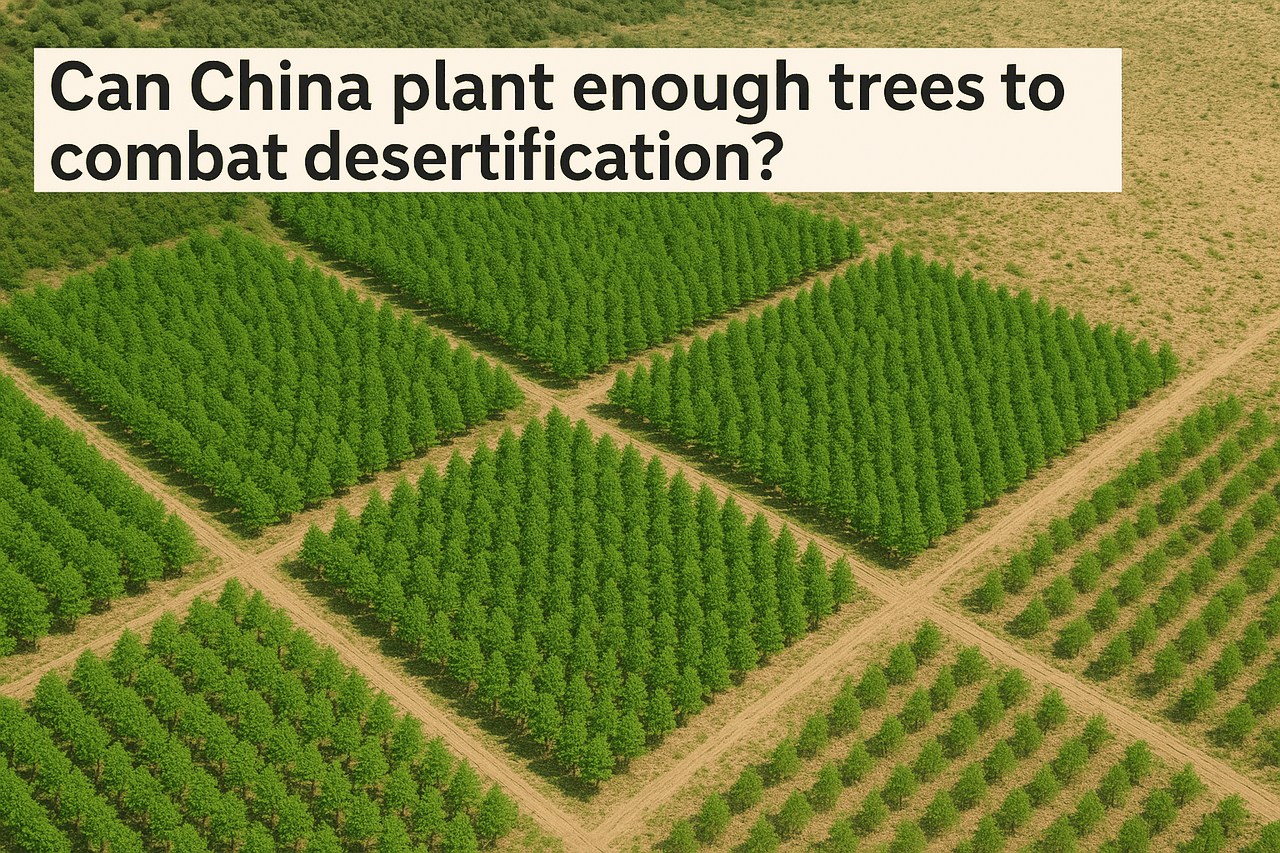
China is making significant strides in combating deforestation and climate change through one of the world’s most ambitious afforestation programs. Guided by long-term ecological preservation policies, the country has cultivated more than 80 million hectares of planted forests, the largest total of any nation. This area is equivalent to over 112 million soccer fields.
As a result, China’s forest coverage has more than doubled—from roughly 12% in the 1980s to over 24% today—an expansion comparable to adding a forest the size of Germany. Major initiatives such as the Three-North Shelterbelt Program, often referred to as China’s “Great Green Wall,” have played a central role in reshaping the country’s ecological landscape.
A Growing Carbon Sink
The impact of China’s forest expansion extends far beyond land restoration. These forests now function as a powerful carbon sink, absorbing an estimated one billion tons of carbon dioxide each year. This represents roughly 2.5–3% of global annual emissions, underscoring the importance of afforestation in climate mitigation.
Such progress is the result of decades of sustained investment, including programs that encourage converting marginal farmland back into forest and grassland. These efforts have fundamentally altered land use patterns while improving biodiversity, soil stability, and ecological resilience.
Global Implications
Globally, annual carbon dioxide emissions remain around 37 billion tons, and many countries continue to struggle with meeting their commitments under international frameworks such as the Paris Agreement. Against this backdrop, China’s afforestation achievements offer a tangible, large-scale example of how nature-based solutions can contribute meaningfully to climate goals.
If similar long-term planting and restoration strategies were adopted elsewhere, they could help offset a significant share of annual emissions and support global progress toward carbon neutrality.
Looking Ahead
China plans to further increase forest coverage to 26% by 2030, aligning afforestation with its broader goals of peaking carbon emissions and achieving carbon neutrality. By continuing to invest in ecological restoration, the country strengthens its own environmental resilience while offering practical insights to the international community.
China’s experience highlights a key lesson: local conservation efforts, when pursued at scale and over time, can generate measurable global climate benefits.