
Key Points
China’s military robots are revolutionizing warfare with AI-powered drone swarms, stealth UAVs, and deep-sea gliders. From the best-selling CH-5 strike drone to record-breaking underwater technology, explore how autonomous systems are reshaping the battlefield.
The global military robotics market is experiencing explosive growth, projected to surge from approximately $15 billion in 2020 to over $49 billion by 2032-2033. In this technological arms race, China has emerged as the world’s second-largest military robot developer after the United States, with a portfolio exceeding 100 models spanning air, land, and sea domains.
China has achieved what industry experts call “overtaking on a different track” through breakthrough innovations in drone swarm technology, AI-assisted decision-making, and low-cost mass production. The country’s spectacular demonstrations of thousand-drone swarms showcase a revolutionary “swarm tactic” capability that could fundamentally transform the future battlefield.
Rainbow Series: The World’s Best-Selling Strike Drones
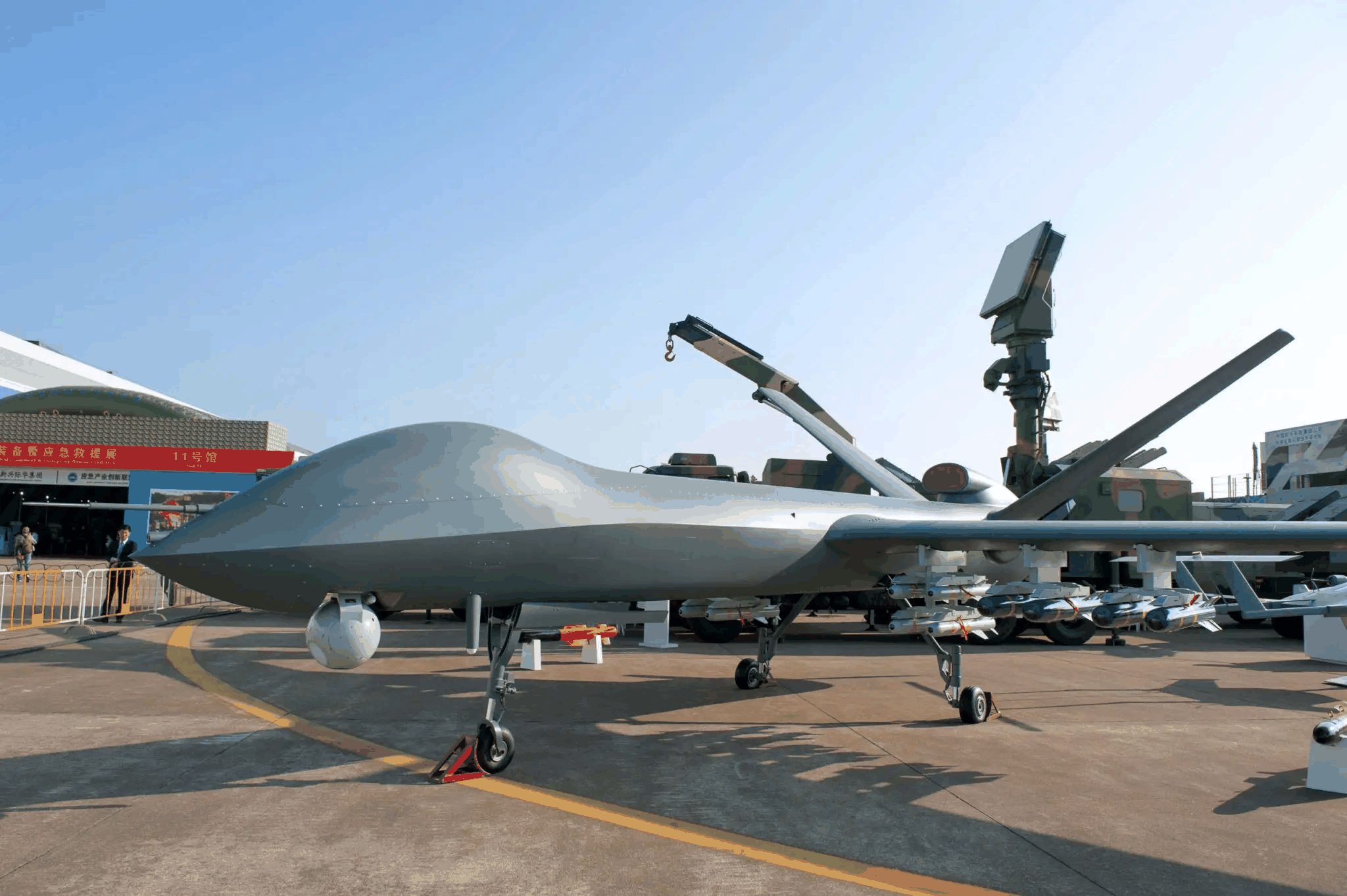
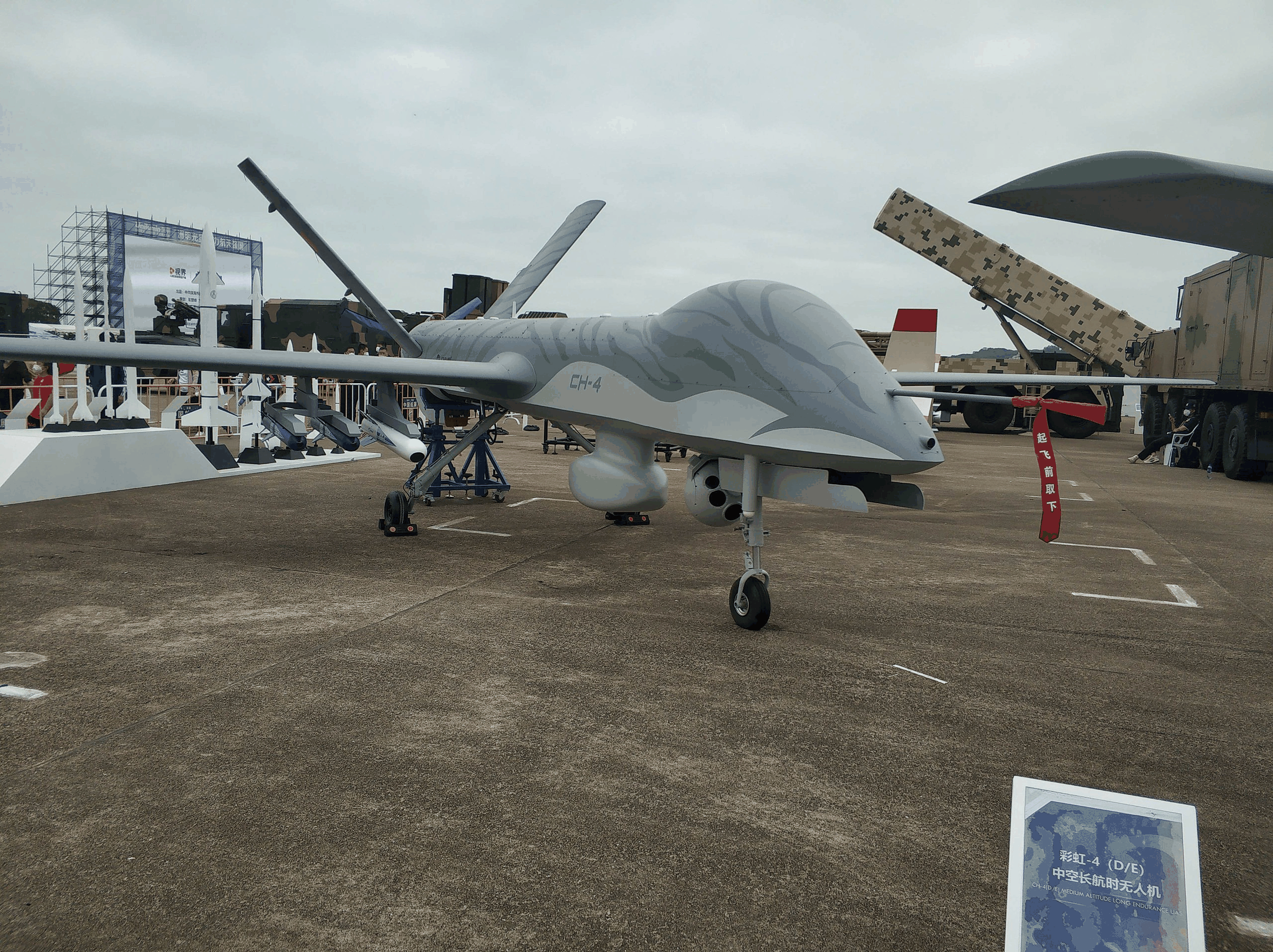
The CH-4 and CH-5 represent flagship products developed by China Aerospace Science and Technology Corporation. The CH-5 boasts impressive specifications: a 21-meter wingspan, maximum takeoff weight of 3.3 tons, 40-hour endurance, operational range exceeding 10,000 kilometers, and the capacity to carry up to 16 missiles.
The series has gained significant international traction. After combat deployment of the CH-4, the Iraqi military made the decisive choice to abandon plans for purchasing American Predators, instead opting to upgrade to the CH-5. The Rainbow series has been exported to over ten countries across the Middle East and Africa, compiling a remarkable combat record:
- In March 2019, Saudi forces released footage showing a CH-4 launching an AR1 air-to-ground missile that precisely struck and destroyed a Russian-made T-72 tank captured by Houthi forces.
- According to the Pakistani military, they used the CH-4 drone to engage at least 10 terrorist targets in Balochistan in October 2022.
”Sharp Sword”: China’s Stealth Combat Drone
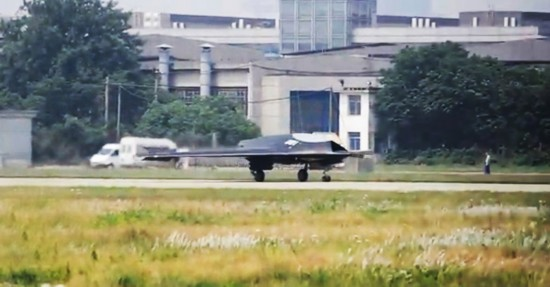
First taking flight in 2013, the “Sharp Sword” features an advanced flying wing design, measuring approximately 10 meters in length with a 14-meter wingspan and exceptional stealth characteristics. Its internal weapons bay accommodates roughly 2 tons of precision-guided munitions, enabling it to penetrate heavily defended airspace for high-risk missions. This achievement positioned China as the third nation after the United States and France to successfully test-fly large-scale stealth drones.
”Sea Wing”: Deep-Sea Champion with Record-Breaking Dive
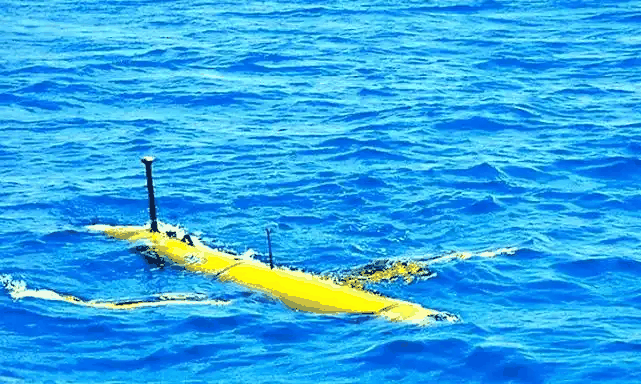
In 2017, the “Sea Wing” descended to 6,329 meters in the Mariana Trench, establishing a world record for underwater gliders. This 3.3-meter-long, 140-kilogram submersible employs biomimetic propulsion, achieving vertical gliding through buoyancy and center-of-gravity adjustments. With remarkably low energy consumption, it can operate continuously in oceanic environments for months.
The “Sea Wing” conducts underwater reconnaissance, collects marine environmental data, and tracks submarines, effectively serving as the Chinese Navy’s “deep-sea sentinel.” In summer 2017, twelve “Sea Wings” operated collaboratively in the South China Sea, collectively covering 7,891 kilometers.
Ground Unmanned Combat Vehicles: The New Mainstay of Land Warfare
China has developed a diverse array of ground unmanned combat vehicles, ranging from tracked to wheeled configurations and reconnaissance to attack variants. These “robot soldiers” equipped with machine guns, missiles, or mine-clearing equipment can execute high-risk missions including mine clearance, breach operations, and fire support. They are fearless and tireless, capable of sustained operations in extreme environments.
The modular design of these unmanned vehicles allows rapid weapon system reconfiguration, creating integrated combat capabilities encompassing reconnaissance, attack, air defense, and engineering support—functioning as a coordinated robotic force.
Future Outlook: Three Trends Shaping Intelligent Warfare
- Intelligence: From Remote Control to Autonomous Decision-Making
Future military robots will possess autonomous mission planning, target recognition, and threat assessment capabilities. Human operators will focus on setting strategic objectives while maintaining ultimate control authority.
- Swarming: From Individual Combat to Coordinated Swarm Tactics
Hundreds or thousands of unmanned systems will operate in coordination, generating three-dimensional, networked superiority across air, ground, and underwater domains.
- Integration: From Substitutes to Force Multipliers
Deep integration of manned and unmanned systems will become standard—fighters commanding unmanned wingmen, tanks paired with unmanned vehicles—achieving true “human-in-the-loop” hybrid warfare capabilities.
Unmanned vehicles, achieving “human-in-the-loop” hybrid warfare.
Conclusion
Through sustained technological breakthroughs, Chinese military robots are evolving from “followers” to “leaders,” ushering in a new era of intelligent and unmanned warfare. While advancing these capabilities, China also advocates for responsible development and deployment of autonomous systems. After all, the most effective weapons are those that serve as deterrents and never need to be employed.