

The lunar calendar’s dance with the sun determines when Spring Festival arrives each year
Mark your calendars: Chinese New Year 2026 falls on February 17—almost three weeks later than 2025’s January 29 date. This dramatic 19-day shift puzzles many people, but the answer reveals the elegant mathematics behind China’s ancient calendar system.
The Shocking Date Gap
2025 (Snake Year): January 29
2026 (Horse Year): February 17
Difference: 19 days later
Why such a huge jump? The culprit is a leap month hidden in the 2025 lunar calendar.
The Leap Month Mystery
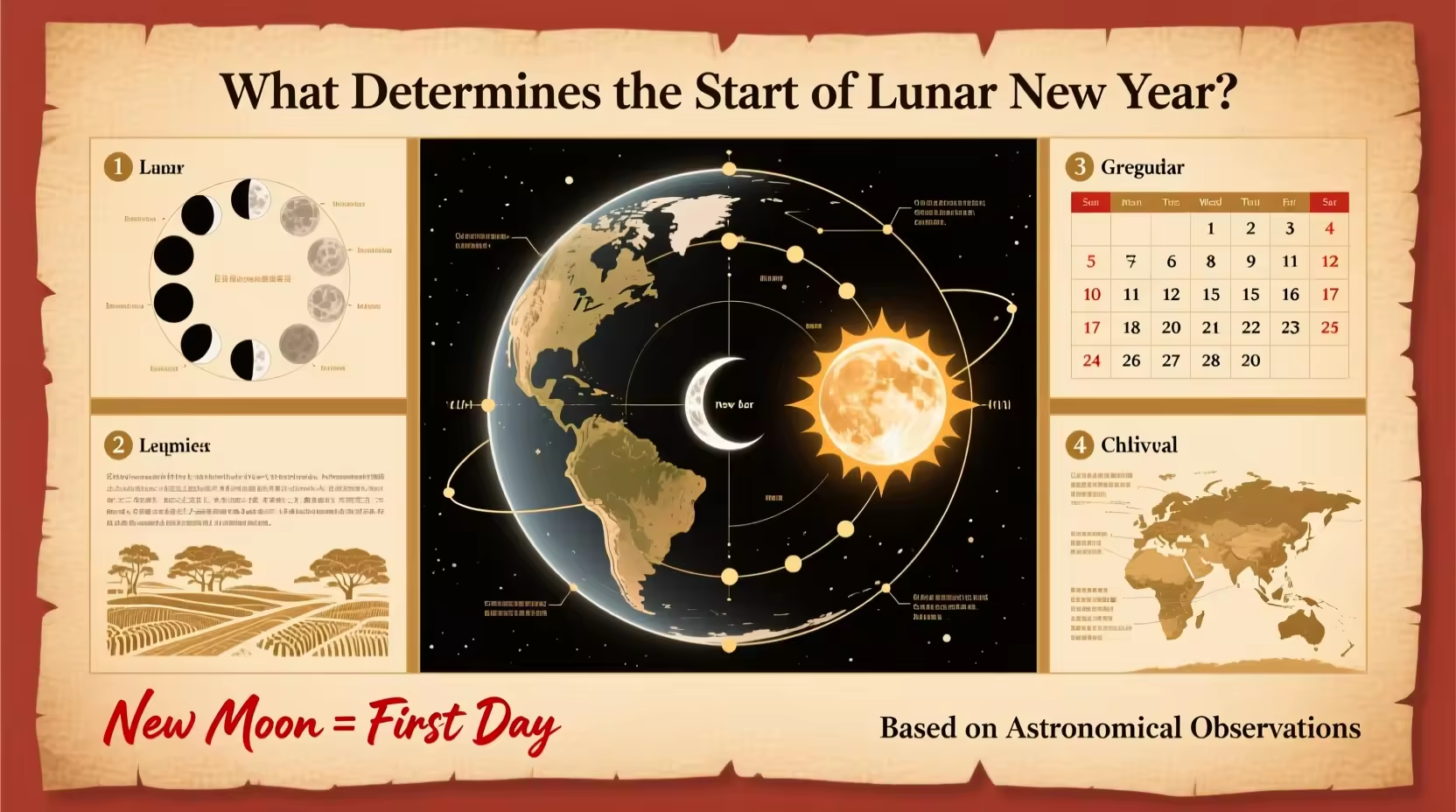
How adding an extra month keeps the lunar calendar aligned with seasons
Here’s the problem: A lunar year (following moon phases) has only 354 days, while a solar year has 365 days. That’s an 11-day gap. If left unchecked, Chinese New Year would eventually drift into summer, then autumn, then winter—completely losing its connection to spring.
The solution? Every few years, the Chinese calendar inserts an extra month called a leap month (闰月). Think of it as hitting the “pause button” to let the solar calendar catch up.
2025 is a leap year with an extra sixth month (闰六月), extending it to 384 days instead of the usual 354. This extra month makes 2025’s Spring Festival arrive early—but pushes 2026’s much later as a result.
The Pattern: Early Year, Late Next Year
When a lunar year has a leap month:
- That year’s Spring Festival comes relatively early
- Next year’s Spring Festival shifts ~ 19 days later
When a lunar year has no leap month:
- Next year’s Spring Festival advances ~ 11 days earlier
This creates a perpetual dance between the lunar and solar calendars, with Spring Festival dates bouncing between January 21 and February 20 every year.
Why February 17 Specifically?
Chinese astronomers at Purple Mountain Observatory—China’s official timekeeper—use precise astronomical calculations to determine Spring Festival. The rules are complex, but essentially:
- Spring Festival must fall on the new moon (when the moon is completely dark)
- It must occur near the Beginning of Spring solar term (立春, around February 4)
- The lunar month must contain the Rainwater solar term (雨水, February 18-21)
In 2026, these astronomical conditions align on February 17—making it one of the latest Spring Festivals in decades.
The “Double Spring” Bonus
Here’s a fun fact: Because 2025 is so long (384 days), it contains two Beginning of Spring solar terms:
- February 3, 2025 (early in the year)
- February 4, 2026 (at year’s end)
This “double spring year” (两头春) happens regularly but has no special significance—despite folk superstitions claiming otherwise. It’s simply math.
Historical Extremes
Earliest possible Spring Festival: January 21, 1966
Latest possible Spring Festival: February 21, 2319
2026’s February 17: Near the extreme late end!
What This Means for You
Travel Planning: Spring Festival rush (春运) centers on mid-February 2026, not late January—plan accordingly.
Holiday Dates: The official 2026 Spring Festival vacation runs February 14-22 (9 days total with adjusted workdays).
Weather Impact: Mid-February celebrations mean slightly warmer weather compared to late January festivals—better for outdoor activities.
Business Closures: International companies working with Chinese partners should note the later timing when scheduling 2026 Q1 activities.
The Beauty of the System
The Chinese lunar calendar isn’t just tradition—it’s a 3,000-year-old astronomical computer that balances moon phases, solar position, and seasonal changes with remarkable precision.
Every Spring Festival date is calculated by actual astronomy, not arbitrary rules. The “late” 2026 date isn’t a mistake or anomaly—it’s the exact moment when lunar cycles, solar terms, and seasonal alignment perfectly intersect.
Quick Answer
Why is 2026 Chinese New Year so late?
Because 2025 has a leap month (an extra month added to keep the lunar calendar aligned with seasons). This makes 2025’s Spring Festival early (January 29) but pushes 2026’s date much later (February 17)—a 19-day shift that’s completely normal in the lunar calendar cycle.
So when you celebrate the Year of the Horse on February 17, 2026, you’re witnessing the product of ancient wisdom and modern astronomy working together—a system that has guided Chinese civilization for millennia and will continue with mathematical precision for thousands of years to come.