
The Secret of the Ice Source
All ice for the Ice and Snow World comes from the natural ice of the Songhua River. Ice formed in calm waters appears slightly green due to aquatic plants, while ice from the river’s center is pure and blue.
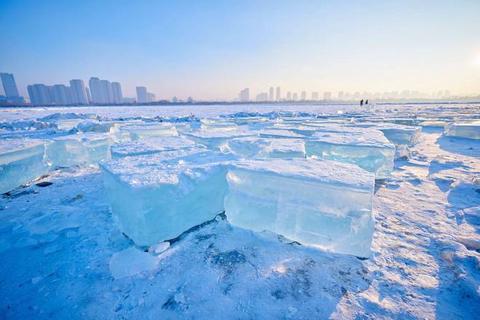
To ensure quality, harvesting only begins when the ice layer reaches a thickness of over 30 centimeters, sometimes reaching 80-90 centimeters at its thickest.
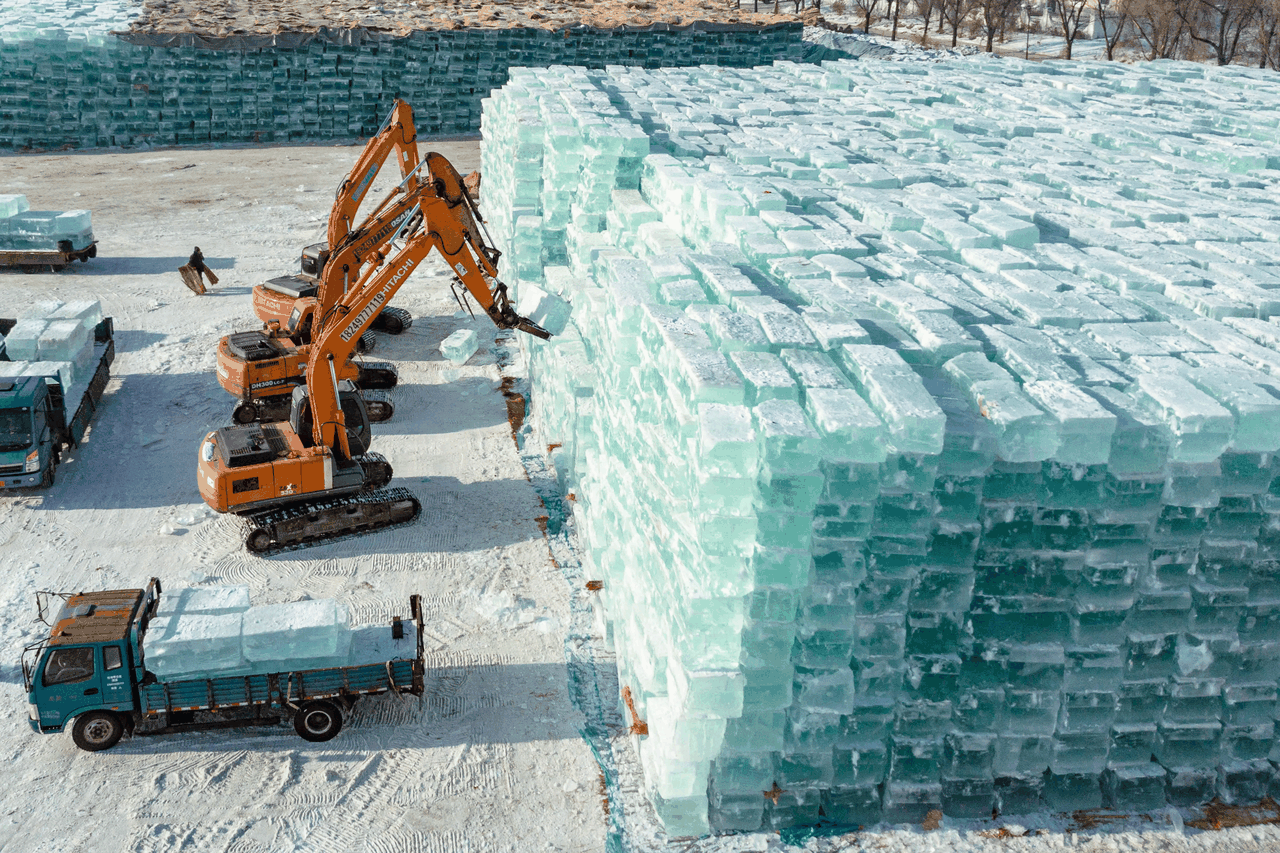
Contrary to common belief, the Ice and Snow World uses not only newly harvested ice but also stored ice from previous years. For the 27th Ice and Snow World in 2025, approximately 200,000 cubic meters of stored ice was utilized.
These blocks, harvested the previous season, are preserved for nearly a year under special “thick quilt”-style insulation materials.
The Art of Harvesting
Ice harvesting is a skilled craft requiring teamwork and physical strength. Each standard block measures about 1.6 meters long, 0.8 meters wide, and weighs over 700 pounds.
Harvesting crews start work at 4 AM, first using ice saws to cut a grid pattern on the surface. Then, with ice chisels weighing over 20 pounds, they strike along the lines to “crack” the ice layer into floating sections.
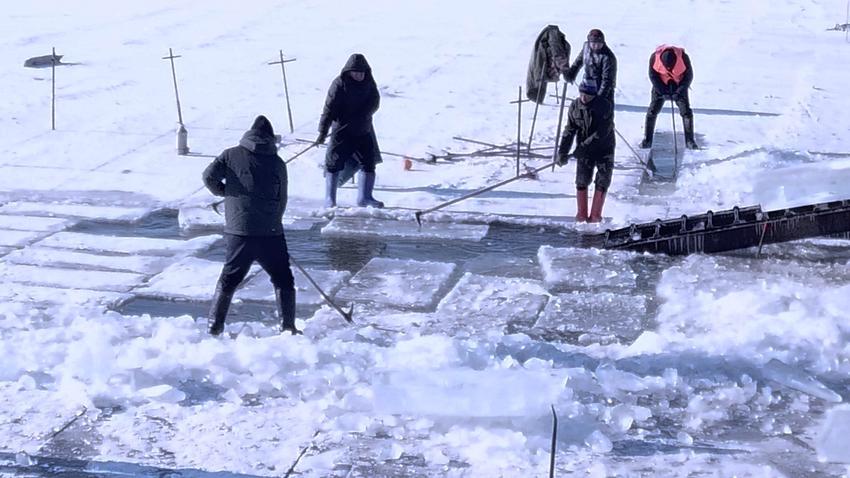
Standing on these sections, harvesters use chisels to separate them along the grid lines, creating individual ice bricks.
The blocks are moved with ice forks to loading machines, then transported by forklifts to the Ice and Snow World construction site.
Before entering the park, each block undergoes multiple inspections for thickness, dimensions, and purity to ensure it meets construction standards.
The Technique of Construction
The Ice and Snow World typically has a construction period of only around 15 days. To meet deadlines, work continues 24/7 in three shifts.
At peak times, over 10,000 workers are on site. Construction methods include “rough ice” and “finished ice” masonry.
Workers first cut the ice blocks with power saws, then lay them layer by layer. During assembly, water is poured into the gaps between blocks, freezing them together—a process called “sealing.”
Each layer must be uniform in height, with blocks staggered between layers by at least 15 centimeters to ensure structural stability.
The Power of Technology
Behind Harbin’s ice and snow industry lies robust technological support. Harbin Institute of Technology has developed intelligent automated standard ice block production equipment.
- Using multi-sensor data fusion and AI visual recognition, it automatically perceives and judges block posture for smart production.
- The lighting control system operates stably in extreme cold as low as -40°C, giving the ice structures a soft, radiant glow.
Harbin’s refrigeration technology is also advanced. Local companies have developed direct evaporation cooling technology, which saves 30%-40% in energy consumption compared to traditional methods and has been used in major events like the Beijing Winter Olympics and the Harbin Asian Winter Games.

The Soul of Culture
Ice harvesting is not just a production activity but also carries deep cultural traditions. China’s history of harvesting and using ice dates back over 3,000 years to the Shang and Zhou dynasties.
The Book of Songs records: “In the second month, we chop the ice with clinking blows; / In the third month, we store it in the ice-house.”
Modern ice harvesting in Harbin gained scale with the first Ice Lantern Garden Party at Zhaolin Park in 1963, which marked the official beginning of Harbin’s ice and snow culture as we know it today.
Today, at each Ice Harvesting Festival, a traditionally dressed “ice master” recites blessings, thanking nature and praying for peace—a continuation of the ancient ethos of “revering heaven and cherishing objects.”

By the Songhua River, crystal-clear ice blocks are transported to the Ice and Snow World, where master carvers await their “building materials.”
The 27th Ice and Snow World expanded to 1.2 million square meters, using 400,000 cubic meters of ice and snow—the largest in its history. Through artisans’ skill, Songhua River ice transforms into dazzling castles and slides.
After melting, some high-quality ice is preserved for reuse the following year, beginning the cycle anew.