
Summary: This article explores how China is reshaping its energy security through a “land-sea coordination” import network, a consumer-side revolution led by new energy industries, and massive strategic reserves. It marks a transition from a passive recipient to an active shaper of global energy dynamics.
Keywords: Energy Security, Land Power Strategy, New Energy Transition, Supply Chain Resilience
The Blockaded Chokepoint and the Calm Dragon
What would happen if the world’s most important oil shipping lane—the Strait of Hormuz—were to be cut off?
For most nations, the answer is runaway inflation, industrial paralysis, and social upheaval. In 2026, due to ongoing geopolitical spillovers in the Middle East, oil transit through this strait—just 33 kilometers wide at its narrowest—has plummeted from a normal 20 million barrels per day to a few hundred thousand, even hitting zero at times.
Yet, amidst this global energy storm, China—the world’s largest importer of both crude oil and natural gas—has remained remarkably composed. Oil prices have not shattered its economic defenses, and social operations continue with steady order. Observers abroad cannot help but ask: As the global energy map trembles, why does China stand so firm?
The answer lies in a systemic, two-decade-long, quietly executed strategy. China is leveraging a strategic hedge of land power against sea power, combined with a structural revolution in energy consumption, to break the so-called “Strait of Malacca / Strait of Hormuz dilemma” long predicted by Western geopolitical scholars.
I. Geographic Breakthrough: Building a “Great Wall of Energy” on Land
For a long time, China’s energy lifelines were seen as being held in foreign hands. Both Hormuz and Malacca are considered “fragile points” under the US global maritime hegemony. To break this over-reliance on a single maritime chokepoint, China has spent the past decade constructing a vast land-based energy artery network spanning its northeast, northwest, and southwest borders, with unmatched execution.
This is not just about laying pipelines; it is about reshaping the geopolitical landscape of the Eurasian continent:
- Northeast Corridor: The China-Russia crude oil pipeline and the “Power of Siberia” natural gas pipeline are fully operational. Russia has surpassed Saudi Arabia as China’s largest source of crude oil imports.
- Northwest Corridor: Lines A, B, and C of the China-Central Asia natural gas pipeline are delivering stable supplies. Even the long-delayed Line D has been accelerated recently. Turkmenistan’s gas flows into China along this “Silk Road,” forming the bedrock of the land power strategy.
- Southwest Corridor: The China-Myanmar oil and gas pipeline bypasses the Malacca Strait entirely. Oil from the Middle East is offloaded directly in Myanmar and piped into Yunnan province, creating a strategic shortcut to the Indian Ocean.
The coordinated operation of these three land corridors provides China with precious “strategic maneuvering room” in the face of a maritime blockade. While Western oil tankers remain trapped in conflict zones, China’s west-east gas transmission network continues to supply heat and power to its eastern metropolises.
II. Tackling the Root Cause: The New Energy Industry Ends “Oil Dependency”
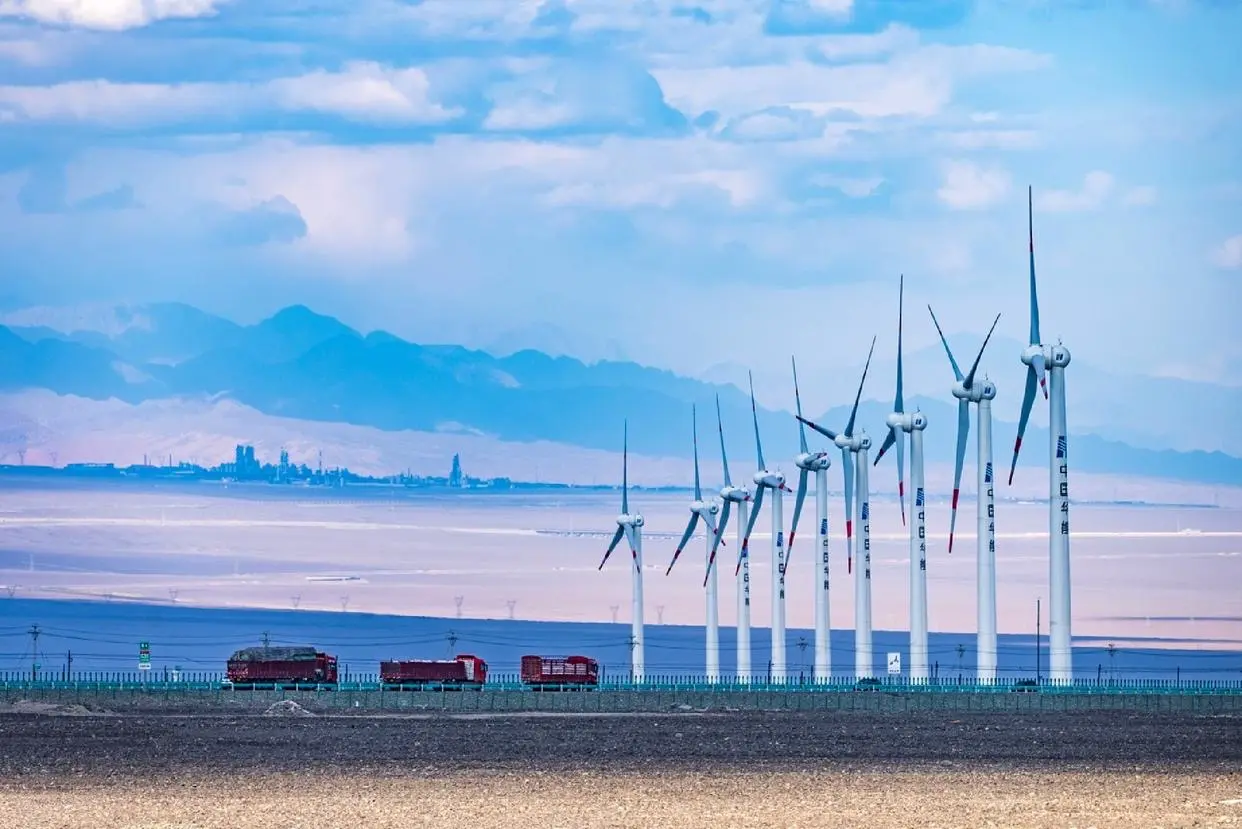
If building pipelines is a physical defense, then China’s comprehensive leadership in the new energy sector is the ultimate “root-and-branch” solution to energy hegemony.
This time, China is not passively adapting to the rules; it is attempting to fundamentally rewrite the script of global energy demand through industrial upgrading.
The first trump card is “electrification.” As of 2025, the penetration rate of new energy vehicles (NEVs) in China has exceeded 50%, with nearly 32 million NEVs on the road. What does this mean? It means that the amount of oil China saves annually through EV adoption is roughly equivalent to its total imports from Saudi Arabia. As the transport sector electrifies, the strong correlation between China’s economic growth and its oil imports is being decisively severed.
The second trump card is “green electricity.” China currently accounts for over 40% of global renewable energy capacity, ranking first in the world in both wind and solar power installations. In fact, China’s annual new electricity demand can now almost be met entirely by newly built wind and solar facilities.
A power system less dependent on imported fuel, combined with a transport system less dependent on gasoline, forms a “double insurance” for China’s energy security. As The New York Times noted, China holds two powerful cards to weather energy shocks: electric vehicles and renewable energy.
III. Preparedness: The “Ballast Stones” of Institutions and Reserves
Beyond hard infrastructure and industrial upgrades, China’s resilience also comes from invisible “software” and stockpiles.
On reserves, China has built one of the world’s most secretive strategic petroleum reserve (SPR) systems. External estimates suggest that combining its SPR with commercial inventories, China could sustain normal national operations for up to 7 months, or even 300 days, in the event of a complete cutoff at the Strait of Hormuz. This acts as a massive “buffer airbag” for the nation, capable of absorbing any short-term supply shocks.
In finance and manufacturing, China has steadily advanced RMB settlement for oil and gas trade, achieving substantive breakthroughs in trade with Russia and Saudi Arabia. Moreover, China controls over 80% of the world’s solar module production and 60% of its power battery capacity. This manufacturing dominance ensures that the cost of the energy transition remains in Chinese hands, rather than being subject to speculative swings in international commodity markets.
IV. Conclusion: From Passive Recipient to Active Shaper
The crisis in the Strait of Hormuz has acted as a global-level stress test.
China’s impressive performance in this test is not due to luck, but to long-term strategic determination. China has transformed its past anxiety over energy security into a comprehensive strategic framework covering physical corridors, clean energy, commercial shipping, and financial sovereignty.
As Reuters observed, China is even buying oil and gas from the United States—not to cover shortages, but for diversification and arbitrage. This shift in posture, from “panic buying” to “calm orchestration,” signals that China has left behind its era of passively accepting international oil price shocks and is becoming an active shaper of the global energy system.
China’s story proves a fundamental truth in this turbulent world: genuine security is never about the smooth passage of any single waterway. It lies in the firm grasp of one’s own destiny.