
You can’t talk about Chinese food without talking about noodles. While rice often dominates the conversation about Asian staples, noodles are the true backbone of daily dining for millions of people across China. They are breakfast, lunch, late-night snacks, and symbols of longevity at birthday celebrations.
But to say you “like Chinese noodles” is a bit like saying you “like European cheese.” It’s too broad. The geography of China is vast, and every province, city, and sometimes even specific village has its own way of pulling, cutting, slicing, and serving dough. The variety is staggering.
From the wheat-heavy north to the rice-loving south, and the spicy west to the seafood-rich east, noodles tell the story of the land they come from. This guide takes you on a culinary tour of some of China’s most iconic regional noodle dishes.
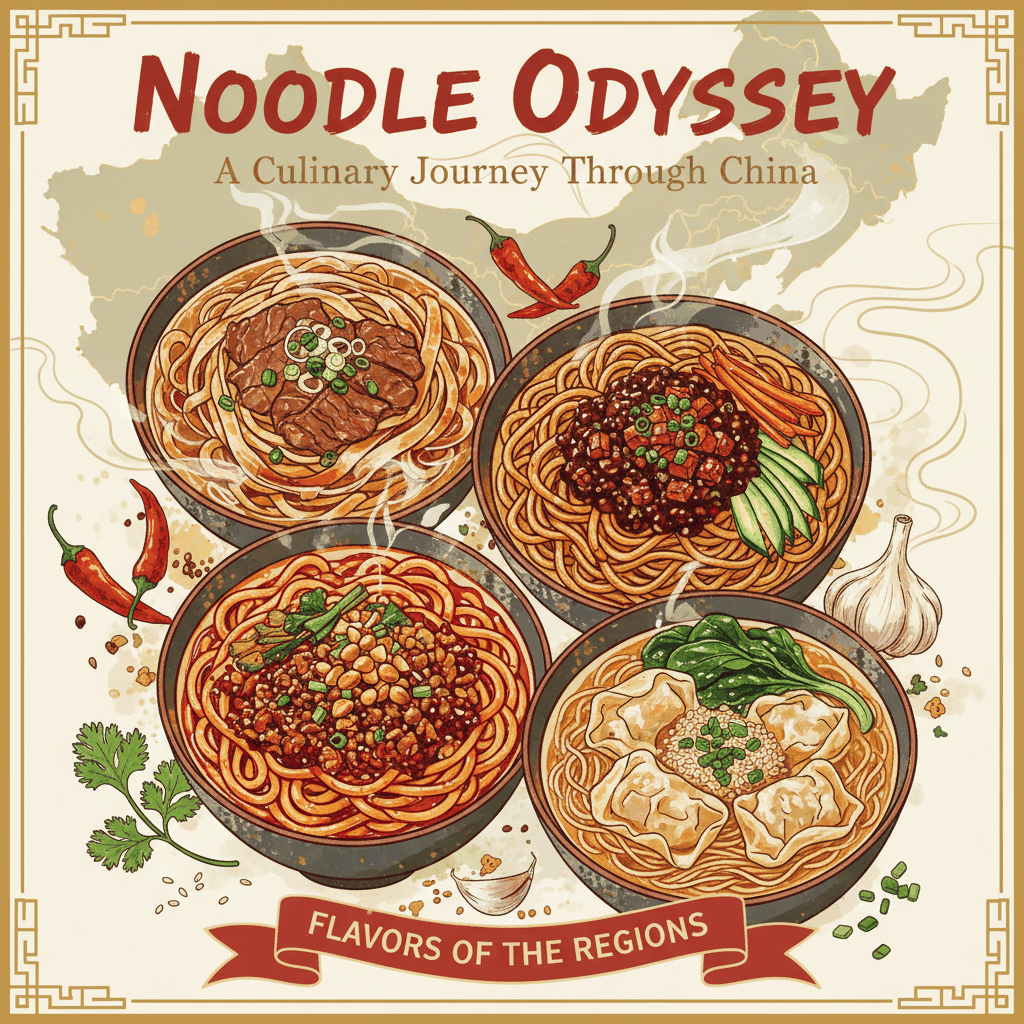
The Northern King: Lanzhou Beef Noodles (Lanzhou La Mian)
In the northwest province of Gansu, the city of Lanzhou wakes up to the smell of beef broth. This isn’t just a dish; it’s a morning ritual. Lanzhou Beef Noodles are arguably the most famous noodles in China, known for their strict standards and incredible freshness.
The Art of the Pull
The magic of this dish lies in the “la” (pulling). A master noodle maker takes a lump of dough and, with a series of rhythmic stretches, folds, and twists, transforms it into thousands of thin, uniform strands in seconds. It is mesmerizing to watch. The dough contains a special alkaline ash called peng hui, which gives it a distinct yellow hue and a springy, chewy texture that machines simply cannot replicate.
The Five Colors
Authentic Lanzhou beef noodles must feature five specific colors to be considered genuine:
- Clear: The beef broth must be clear, not cloudy.
- White: Slices of white radish (daikon) soften in the soup.
- Green: A generous handful of cilantro and garlic leeks.
- Red: A ladle of bright red chili oil floats on top.
- Yellow: The noodles themselves.
The result is a bowl that is visually striking and deeply comforting. The broth is aromatic with spices like star anise, cinnamon, and peppercorns, but light enough to drink entirely.
The Spicy Soul of the West: Sichuan Dan Dan Noodles
Heading southwest into the humid, mountainous basin of Sichuan province, the flavors change dramatically. Here, humidity is combated with heat—specifically, the numbing heat of Sichuan peppercorns (hua jiao) and dried chilies. Dan Dan Noodles are the street food king of Chengdu.
A Humble Origin
The name “Dan Dan” comes from the bamboo pole (dan) that street vendors used to carry across their shoulders. One basket held the noodles, the other the sauce. Because they had to be portable, the noodles were served with a small amount of sauce rather than a large bowl of soup.
The Flavor Explosion
These noodles are not about the broth; they are about the sauce. It sits at the bottom of the bowl, a dark, oily, fragrant mixture of chili oil, Sichuan peppercorns, sesame paste, soy sauce, and preserved vegetables (ya cai).
On top sits a scoop of crispy minced pork fried until golden brown. When you receive the bowl, you must mix it vigorously. The white noodles turn a fiery red-brown, coated in the rich, nutty, and spicy sauce. The first bite hits you with the savory pork, followed by the nutty sesame, and finally, the signature ma la (numbing spice) that makes your lips tingle.
The Imperial Classic: Beijing Zha Jiang Mian
In the capital city of Beijing, wheat is the primary crop, and hearty, thick noodles are the preference. Zha Jiang Mian, often translated as “Fried Sauce Noodles,” is pure comfort food. It’s salty, savory, and satisfying—China’s answer to spaghetti bolognese, but darker and earthier.
The Soybean Paste
The soul of this dish is the zha jiang sauce. It is made by frying yellow soybean paste (and sometimes sweet bean sauce) with diced pork belly. The key is to cook the sauce slowly until the oil separates from the paste and the pork fat renders out, creating a glossy, almost black mixture. The flavor is intense, fermented, and salty.
Fresh Accompaniments
Because the sauce is so rich, it is always served with a variety of fresh, crunchy vegetables. A typical bowl will feature piles of julienned cucumber, radish, bean sprouts, and edamame beans arranged neatly over the hand-rolled noodles.
Eating it is an interactive experience. You dump the warm, salty meat sauce over the cold or room-temperature noodles and fresh vegetables, then toss everything together. The crunch of the raw veggies cuts through the salty richness of the pork sauce perfectly.
The Southern Delicate Touch: Cantonese Wonton Noodles
Travel far south to Guangdong province and Hong Kong, and the wheat fields disappear, replaced by rice paddies. Yet, wheat noodles still hold a special place here, though they look very different from their northern cousins. Cantonese Wonton Noodles are all about delicacy, precision, and “bounce.”
The Bamboo Press
The noodles used here are thin, yellow, and incredibly springy. This texture is traditionally achieved using a large bamboo pole. The chef sits on one end of the pole and bounces up and down to press the dough, removing air bubbles and creating a dense, firm texture known as shuang (snappy or al dente). These are often egg noodles, sometimes made specifically with duck eggs for a richer flavor and better texture.
The Sea in a Bowl
Unlike the heavy beef broths of the north, Cantonese soup bases are studies in subtlety. They are typically made from pork bones, dried flounder, and shrimp roe. The broth is golden and clear, brimming with umami from the dried seafood.
The wontons themselves are filled primarily with shrimp and a little pork fat, wrapped in a skin so thin it becomes translucent when cooked, earning them the nickname “goldfish tails.” A proper bowl places the spoon at the bottom, the wontons in the middle, and the noodles on top to keep them from getting soggy in the hot soup.
The Central Spice: Wuhan Hot Dry Noodles (Re Gan Mian)
In Central China, the city of Wuhan has a breakfast culture that rivals any in the world. The star of the show is Re Gan Mian, or Hot Dry Noodles. While other regions might prefer soup, Wuhan locals want their noodles hot, dry, and coated in a thick, sticky sauce.
The Sesame Secret
The defining characteristic of Hot Dry Noodles is the alkaline treatment of the noodles, which are par-boiled, oiled, and dried before being quickly scalded in hot water to serve. This gives them a firm, substantial bite.
But the flavor comes from the sauce: a heavy, generous pour of sesame paste (similar to tahini but toasted and darker), mixed with soy sauce, chili oil, and garlic chives. The sauce is thick—almost like peanut butter in consistency—and clings to every strand of noodle. It’s rich, nutty, and caloric, designed to fuel workers through a long day. The heat from the chili cuts the heaviness of the sesame, creating a balance that locals crave every morning.
Beyond the Bowl: A Cultural Reflection
What makes Chinese noodle culture so fascinating is not just the taste, but how these dishes reflect the environment.
- In the cold, dry North, heavy wheat noodles and warm beef soups provide necessary calories and warmth.
- In the hot, humid Southwest, spices induce sweating to cool the body down and preserve food in damp climates.
- In the coastal South, fresh seafood ingredients dictate a lighter, more delicate approach to soup making.
- In the bustling cities, convenience drives the creation of dry, mixed noodles that can be eaten quickly on a street corner.
When you sit down to a bowl of Chinese noodles, you are eating history. You are tasting the local wheat or rice harvest, the preferred preservation methods of the region (pickling, drying, fermenting), and the local palate preferences developed over centuries.
So, the next time you crave Chinese takeout, look past the general “Lo Mein.” Seek out the hand-pulled ribbons of Lanzhou, the fiery bowls of Chongqing, or the snappy bounce of a Cantonese egg noodle. Your palate will thank you for the journey.