
Quick Tips for Staying Warm During the Coldest Seasons
-
Protect Your “Entrances”: Traditional Chinese medicine advises keeping your head, neck, and feet warm, as these are points where cold can enter the body. Wear hats, scarves, and warm socks.
-
Eat Warming Foods: Incorporate foods like ginger, beef, lamb, and walnuts into your diet. These are considered “warming” and can help bolster your body’s internal heat during the coldest winter months.
-
Follow the Sun: The “Counting of Nines” reminds us to align with nature. Try to sleep early and wake a little later, waiting for the sunlight to appear, to conserve your body’s energy.
The Origin of Counting Nines: Wisdom in Winter
The tradition of “Counting of Nines” dates back over 1,400 years to the Northern and Southern Dynasties in China. It is a practical and poetic system for tracking the coldest days of winter and anticipating the arrival of spring. The practice begins on the Winter Solstice (Dongzhi), which is the shortest day of the year in the Northern Hemisphere.

Why start on the Winter Solstice? While this day receives the least amount of solar energy, the ground still retains residual heat from autumn. The real deep cold sets in afterward, as the earth loses more heat than it absorbs. This cumulative heat loss peaks during the third and fourth “nines,” making them the most frigid periods of the year. This demonstrates the ancient Chinese understanding of a key climatic principle: the lag effect. The coldest days of winter arrive well after the day with the least sunlight.
In Chinese culture, the number nine is considered a “yang” or positive number. It is the largest single digit, symbolizing an apex. The repeated accumulation of this “yang” number signifies the gradual decline of “yin” (cold, dark energy) and the steady return of warmth and light. Essentially, “Counting of Nines” is a hopeful countdown to spring.
How to Count the Nines: An 81-Day Journey
The method is simple. Starting from the Winter Solstice, every nine-day period marks one “nine.” This continues for a total of 81 days, covering the major solar terms of Minor Cold, Major Cold, Start of Spring, Rain Water, and Awakening of Insects.
Here is a general timeline for the 2025-2026 winter season:
-
First Nine: December 21, 2025 – December 29, 2025
-
Second Nine: December 30, 2025 – January 7, 2026
-
Third Nine: January 8, 2026 – January 16, 2026
-
Fourth Nine: January 17, 2026 – January 25, 2026
-
Fifth Nine: January 26, 2026 – February 3, 2026
-
Sixth Nine: February 4, 2026 – February 12, 2026
-
Seventh Nine: February 13, 2026 – February 21, 2026
-
Eighth Nine: February 22, 2026 – March 2, 2026
-
Ninth Nine: March 3, 2026 – March 11, 2026
After the 81 days are complete, it is said that spring has truly arrived.
Folk Rhymes: The “Nine-Nine Songs”
Without modern weather forecasts, people in ancient China relied on experience passed down through generations. The “Nine-Nine Songs” (九九歌) are catchy folk rhymes that describe the weather changes and agricultural activities during each nine-day period. Because of China’s vast territory, these songs vary by region.
A widely known version from Northern China goes:
-
“In the first and second nines, don’t show your hands.” (It’s too cold.)
-
“In the third and fourth nines, you can walk on ice.” (The peak of winter’s cold.)
-
“In the fifth and sixth nines, see willows along the river banks.” (Signs of spring emerge.)
-
“In the seventh nine, the rivers thaw; in the eighth nine, the wild geese return.”
-
“After the ninth nine is done, the plowing oxen are seen everywhere.” (Farming season begins.)
This simple rhyme paints a vivid picture of the transition from deep winter to vibrant spring, serving as both a weather guide and a reminder of the agricultural calendar.
Artistic Pastimes: The “Nine-Nine Dispersing Cold Pictures”
To make the long wait for spring more engaging, ancient Chinese people developed artistic customs. The “Nine-Nine Dispersing Cold Pictures” (九九消寒图) turned the 81-day countdown into a creative and mindful activity.
-
Painting the Nines (画九): This often involved a drawing of a plum blossom branch with nine blossoms, each having nine petals, for a total of 81 petals. Each day, one petal would be painted. As the painting gradually filled with color, so too did the world outside fill with the warmth of spring.
-
Writing the Nines (写九): This involved a nine-character phrase, with each character composed of nine strokes. A famous example is “亭前垂柳珍重待春風” (The willow in front of the pavilion treasures the wait for the spring wind). Each day, one stroke would be filled in with ink. Some would even note the day’s weather next to the stroke, creating a personal meteorological record.
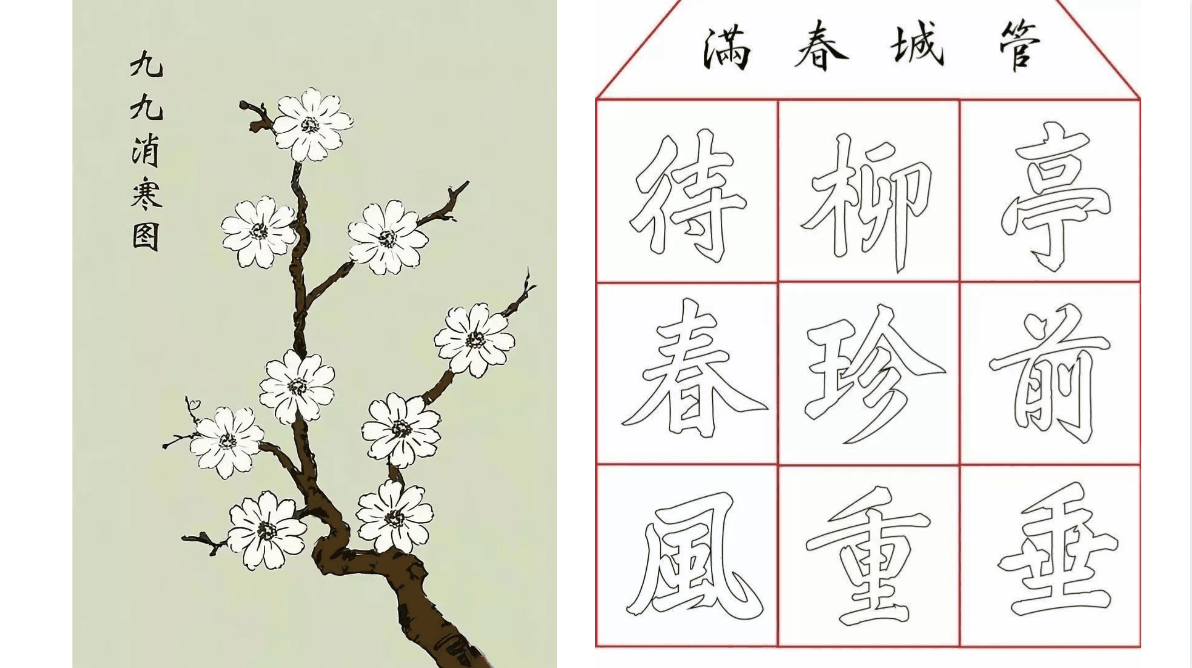
These practices transformed a period of cold and inactivity into a ritual of patience, observation, and artistic expression, reflecting a deep philosophical acceptance of nature’s cycles.
Conclusion: Enduring Wisdom for Modern Times
The tradition of “Counting of Nines” is more than just a folk calendar. It is a beautiful testament to the observational skills and wisdom of ancient Chinese people. It combines practical meteorology with poetry, art, and philosophy, teaching a lesson of patience and harmony with the natural world. In our modern era of instant forecasts, this custom reminds us to slow down, observe the subtle changes in the seasons, and appreciate the slow, steady, and inevitable return of spring after a long, cold winter.