
Quick Tips for Understanding Brocade Craftsmanship
- Examine the precious threads: Authentic royal brocades often incorporate luxurious materials into the weave, including pure gold or silver threads, creating a luminous, three-dimensional effect that changes with the light.
- Notice the regional styles: Each brocade reflects its geographic origin. Imperial styles from Nanjing focus on lavish dragon motifs, while minority styles from Guangxi feature vibrant, nature-inspired geometric patterns.
- Appreciate the manual labor: Traditional brocade requires complex wooden Jacquard looms. The most intricate styles demand two artisans working in perfect sync just to weave a few centimeters of fabric a day.
The Historical Tapestry of China’s Silk Heritage
As the birthplace of silk, China has a textile history that stretches back millennia. While plain silk is beautiful in its own right, brocade elevates the material into a structural work of art. Brocade is a class of richly decorative shuttle-woven fabrics, often made with colored silks and sometimes with gold and silver threads.
Think of brocade as the haute couture of the ancient world. Just as European royalty commissioned intricate tapestries from Flanders to display their wealth and power, Chinese emperors and aristocrats relied on brocade to signal status, fund armies, and conduct diplomacy. Over centuries of development, four distinct regional styles emerged as the undisputed masters of this art form, collectively known as the Four Great Brocades.
Exploring the Four Great Brocades
Each of the four major brocade traditions offers a unique window into the history, economy, and aesthetics of its time.
Nanjing Yunjin: The Fabric of Emperors
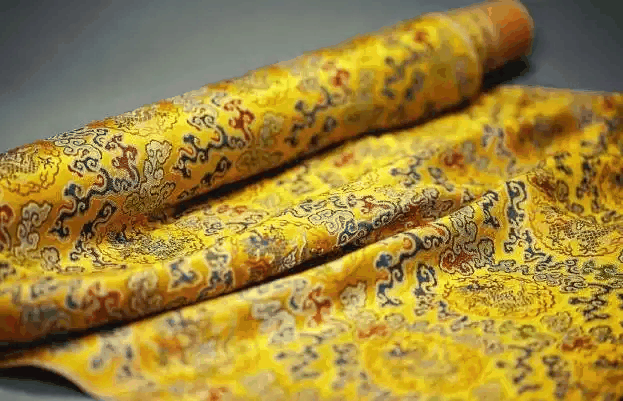
Translating directly to “Cloud Brocade,” Nanjing Yunjin earned its name because its complex, vivid patterns resemble colorful clouds in the sky. Originating in the late Eastern Jin Dynasty (around 417 AD), this craft reached its absolute zenith during the Ming and Qing dynasties.
Nanjing Yunjin is the equivalent of royal bespoke tailoring. For centuries, it was exclusively reserved for the imperial family, used to create the emperor’s dragon robes and attire for high-ranking officials. The craftsmanship relies on a massive, two-story wooden loom. A “pattern puller” sits at the top pulling the threads to form the design, while a weaver sits at the bottom shuttling the colored silks. The technique of incorporating spun gold thread and peacock feather filaments makes Yunjin incredibly heavy, luxurious, and impossible to replicate with modern machinery.
Chengdu Shujin: The Silk Road’s Most Coveted Prize
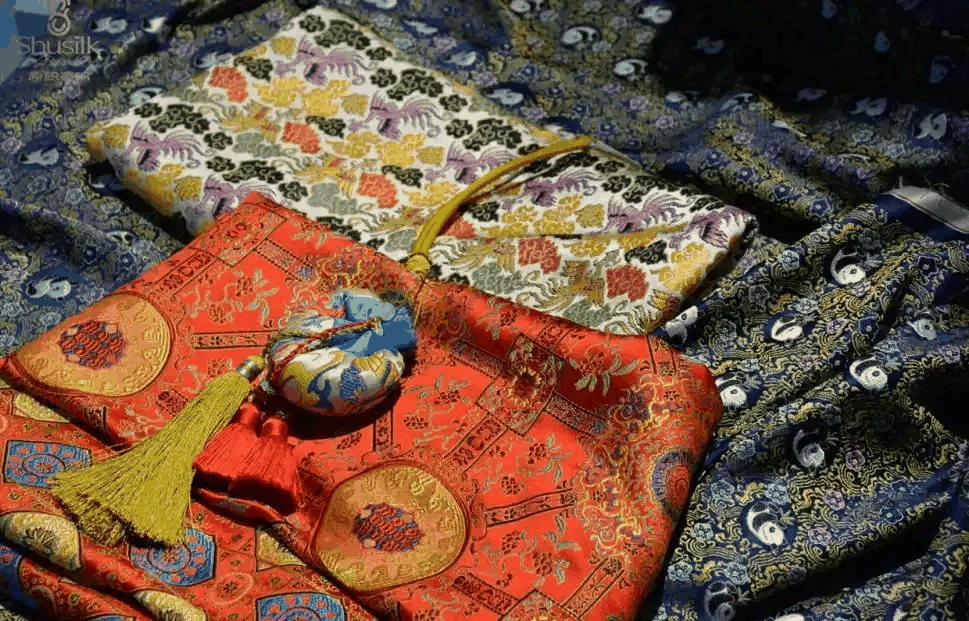
Chengdu Shujin, or Sichuan Brocade, is the oldest of the four, with a history tracing back to the Han Dynasty. It is deeply intertwined with the ancient city of Chengdu, which was historically known as the “City of Brocade.”
During the Three Kingdoms period, the famous strategist Zhuge Liang heavily promoted the production of Shujin. He famously used this valuable textile as currency to fund his military campaigns. Shujin was not just a domestic treasure; it was one of the primary luxury goods exported along the Silk Road. Traders carried these vibrant, warp-faced brocades across deserts to Central Asia, the Middle East, and eventually Europe. Known for its rich red hues and elegant patterns like “moonlight” and “rain silk,” Shujin represents the economic and cultural lifeblood of ancient global trade.
Suzhou Songjin: The Elegant Canvas of Scholars
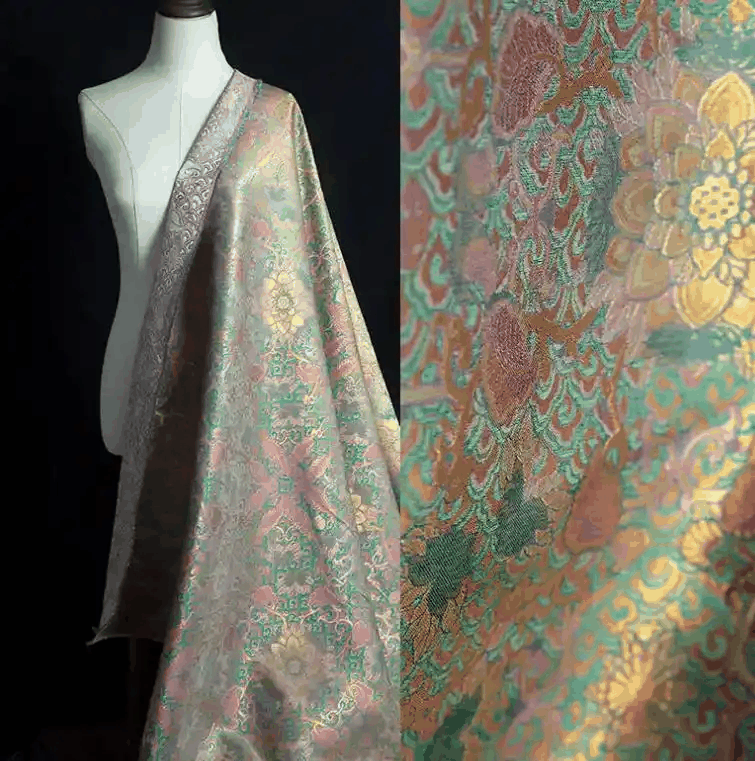
Originating during the Southern Song Dynasty, Suzhou Songjin (Song Brocade) was born out of a moment of historical upheaval. When the imperial court fled south to Lin’an (modern-day Hangzhou), they brought a demand for refined, elegant textiles to decorate their palaces and clothing. Suzhou, already a hub of silk production, stepped up to the challenge.
If Nanjing Yunjin is loud and imperial, Suzhou Songjin is understated and scholarly. It is significantly thinner and softer than other brocades. Because of its delicate texture and refined geometric or floral patterns, Songjin became the preferred material for mounting precious Chinese calligraphy and watercolor paintings. Much like the subtle, perfectly crafted frames used in the Louvre to highlight a Renaissance masterpiece, Songjin was designed to complement and elevate the art it surrounded without overpowering it.
Guangxi Zhuangjin: The Woven Heritage of the People
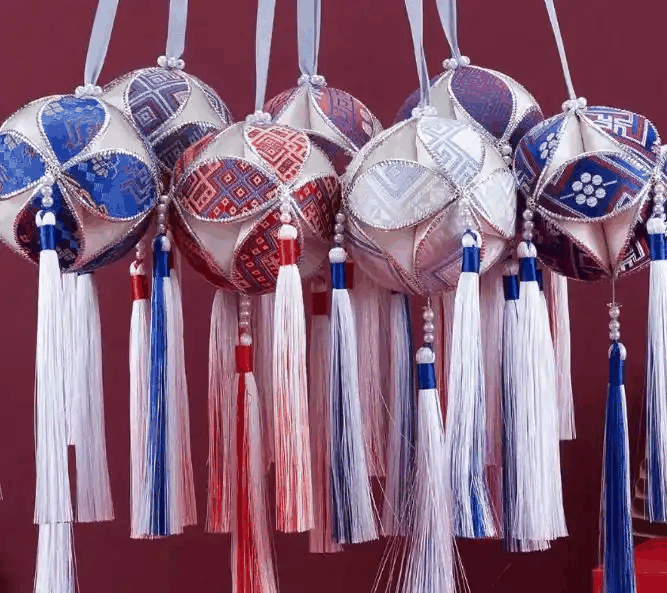
The fourth great brocade, Guangxi Zhuangjin, stands apart from the other three. While Yunjin, Shujin, and Songjin are heavily associated with Han Chinese imperial and scholarly history, Zhuangjin is the proud creation of the Zhuang ethnic minority in southern China.
Zhuangjin typically uses cotton yarns for the warp and brightly colored silk threads for the weft. The craftsmanship results in highly durable, thick fabrics adorned with striking geometric shapes, animals, and floral motifs representing the natural world. Historically, Zhuang women wove this brocade for practical daily use, turning it into blankets, clothing, and essential dowry items. It represents a living, breathing folk art that captures the vibrant spirit, community ties, and indigenous heritage of the Zhuang people.
The Complex Craftsmanship Behind the Looms
The true value of these textiles lies in the staggering complexity of their creation. Before a single inch of fabric is woven, artisans must complete a grueling process of silk reeling, dyeing, and pattern drafting.
The traditional wooden looms used for these brocades operate like early computers. The patterns are “programmed” using thousands of knotted knots and strings, which tell the loom exactly which threads to lift and which to drop. This binary system of craftsmanship is so mathematically complex that it takes years of apprenticeship to master. The meticulous attention to detail ensures that the resulting fabric is flawless, durable, and breathtakingly beautiful.
Preserving an Intangible Cultural Heritage
As industrialization and fast fashion dominate global markets, the survival of these ancient weaving techniques has faced severe threats. Hand-weaving a few inches of Yunjin or Shujin can take a full day of backbreaking labor, making it difficult for traditional workshops to compete with modern factories.
Fortunately, immense efforts are underway to protect this heritage. Several of these weaving techniques have been inscribed on UNESCO’s Representative List of the Intangible Cultural Heritage of Humanity. Today, master weavers are taking on new apprentices, and designers are finding innovative ways to incorporate these ancient fabrics into modern luxury fashion, ensuring that the rhythm of the wooden looms continues to echo into the future.
To truly understand China, one must look closely at the threads that bind its history. The Four Great Brocades offer a tactile, colorful journey through empires, trade routes, scholarly pursuits, and folk traditions, proving that true craftsmanship never loses its luster.