
Quick Tips for Understanding the 095 Submarine
- Focus on the width: The 12.5-meter hull is not for carrying more cargo. It provides the necessary space to install massive shock-absorbing rafts that drastically reduce engine noise.
- Look at the propulsion: The vessel likely utilizes a shaftless pump-jet propulsion system, completely eliminating traditional propeller mechanics and the acoustic signatures associated with them.
- Acknowledge the firepower: Outfitted with large-diameter vertical launch modules, this nuclear submarine can deploy hypersonic anti-ship missiles, allowing for devastating saturated strikes from the deep.
The Dawn of a New Deep-Sea Predator
For over a decade, international defense analysts and naval intelligence agencies have closely monitored China’s shipbuilding facilities, waiting for the next evolution in underwater warfare. Recent high-resolution satellite imagery has finally pulled back the curtain on this highly anticipated vessel.
Spotted in a northern drydock, the sheer scale of the 095 submarine immediately caught the attention of global observers. The imagery reveals a remarkably sleek design with a 12.5-meter beam. This striking physical profile confirms that China has moved past older, noisier submarine models and successfully developed a modern apex predator for the deep ocean.
Breaking the Sound Barrier: Stealth as a Weapon
When evaluating any nuclear submarine, acoustic stealth is the ultimate metric of survival. In the depths of the ocean, sound travels incredibly fast and far. If a submarine emits even a minor mechanical vibration, sophisticated passive sonar networks can detect it from hundreds of miles away.
The 12.5-Meter Hull Advantage
Western military observers initially debated the purpose of the 095’s exceptionally wide hull. Some speculated it was simply to pack in more weaponry. However, the true purpose of this widened frame is survival.
Traditional nuclear reactors generate immense vibration. To silence a reactor, engineers must encase it in heavy, bulky vibration-damping rafts. Older Chinese submarines simply lacked the internal volume to accommodate these massive sound-isolation systems. By expanding the hull width to 12.5 meters, naval engineers created the perfect housing for these critical noise-canceling components, achieving a monumental leap in acoustic stealth.
Shaftless Pump-Jet Propulsion and X-Rudders
The innovations of the 095 submarine extend far beyond its internal soundproofing. Reports indicate that the vessel integrates a shaftless pump-jet propulsion system, a revolutionary piece of military technology championed by leading Chinese naval engineers. By removing the traditional mechanical drive shaft, the submarine eliminates its primary source of mechanical tearing noise. This allows the vessel to maintain incredibly high speeds while remaining completely silent.
Furthermore, the integration of an X-shaped tail rudder enhances its tactical agility. Similar to the designs seen on advanced American and Russian submarines, the X-rudder allows this massive vessel to navigate complex, shallow seabed terrains with the precision and flexibility of a much smaller craft.
Firepower and Tactical Dominance
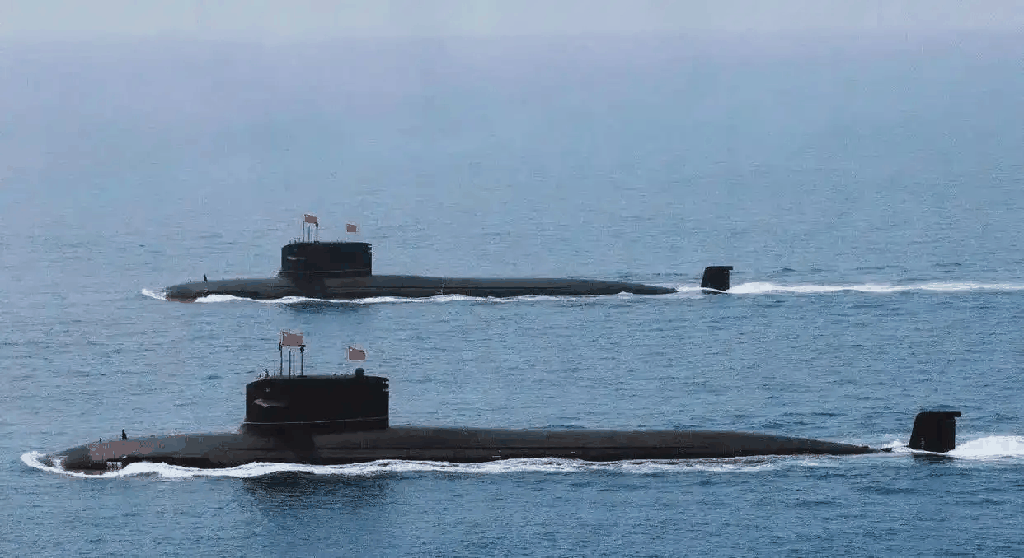
While stealth allows the 095 submarine to evade detection, its payload makes it a formidable strategic deterrent. The vessel transforms the concept of underwater patrol into an active, high-threat offensive capability.
Vertical Launch and Hypersonic Capabilities
The 095 features eight large-diameter vertical launch system (VLS) modules, capable of carrying an estimated 24 advanced missiles. This configuration gives the submarine the ability to launch saturated strikes against enemy surface fleets.
More importantly, these launch cells can deploy cutting-edge hypersonic anti-ship missiles, such as the YJ-19 and YJ-20. With terminal flight speeds reaching Mach 5 or Mach 6, these weapons easily bypass most active air defense systems. When combined with the submarine’s enhanced stealth, adversaries face a dire scenario: by the time they detect the 095 submarine, it may already have launched a hypersonic strike from well within its torpedo or missile range.
The Shifting Tides of Global Military Technology
The emergence of the 095 submarine does not exist in a vacuum; it highlights a broader structural shift in global naval power.
Rapid Shipbuilding vs. Western Constraints
Over the past four years, China has launched an estimated nine to ten major submarines, utilizing a highly efficient, iterative manufacturing process. Each new vessel serves as a testing ground for minor technological refinements, drastically compressing the research and development cycle.
Conversely, Western shipbuilding faces significant bottlenecks. Shipyards struggle with aging infrastructure, severe labor shortages, and massive maintenance backlogs. As skilled welders and technicians age out of the workforce, production has slowed to a crawl. This stark contrast in industrial capacity means that China is rapidly closing the numerical and technological gap that once favored the West.
Strategic Implications for the First Island Chain
For decades, foreign carrier strike groups operated with relative freedom within the First Island Chain, relying on an overwhelming advantage in underwater acoustic intelligence. Extensive sonar networks allowed them to track, monitor, and deter approaching vessels long before they posed a threat.
The 095 submarine fundamentally disrupts this dynamic. By achieving near-complete acoustic silence, it effectively dismantles the “one-way transparency” that previously defined Pacific naval operations. The ocean is no longer a glass bowl for advanced sonar arrays. Instead, it offers a secure cloak for China’s naval forces.
Conclusion
The introduction of the 095 submarine marks a pivotal moment in modern military history. It perfectly merges acoustic stealth, high-speed propulsion, and hypersonic firepower into a single, highly efficient platform. As China continues to rapidly produce and refine this class of nuclear submarine, it builds a formidable underwater deterrent. This vessel ultimately ensures that any external naval force must carefully weigh the severe risks before projecting power into contested maritime territories.